Two training sessions combined classroom and field-based learning on nutrient management, fertigation and integrated crop management under protected agriculture
Basseterre, Saint Kitts and Nevis, 24 September 2026 - Farmers, extension officers and agricultural professionals from Saint Kitts and Nevis strengthened their technical and practical skills through two training sessions covering nutrient management for open-field and protected vegetable production, and integrated crop management in greenhouse systems, delivered by the Food and Agriculture Organization of the United Nations (FAO), in collaboration with the Ministry of Agriculture, Fisheries and Marine Resources.
Held on 21 and 23 September 2026 the sessions focused on nutrient management for vegetable production and integrated crop management respectively under protected cultivation systems. Both combined classroom instruction with practical field sessions and were delivered under the project “Strengthening Protected Agriculture to Improve People’s Livelihoods, Food and Nutrition Security”. The two training sessions attracted a combined attendance of 48 participants, including 14 women and 34 men from Saint Kitts and Nevis.
Mr. Mark Adams, Chief Extension Officer at the Ministry of Agriculture, delivered the opening remarks for the nutrient management training, and emphasized the importance of strengthening technical capacity to support more efficient and resilient vegetable production. He noted, “Our goal must be to leave this workshop with a clearer understanding of not only how fertigation works, but how it can be used responsibly to improve crop productivity, conserve limited resources and strengthen the profitability and resilience of our farmers.”
During the training on nutrient management, participants examined crop nutrient requirements, fertilizer formulations and nutrient content, fertilizer selection and calculations, and considerations for open-field and protected cultivation. They also worked with a nutrient-management calculation tool to determine fertilizer requirements for soil-based and hydroponic systems at different stages of crop development.
Mr. Melvin Medina Navarro, Senior Policy Officer at the FAO Regional Office for Latin America and the Caribbean, emphasized the importance of matching nutrient applications to crop requirements. He emphasized, “Effective nutrient management means providing the crop with the right nutrients, in the right amounts and at the right stage of growth. Understanding fertilizer composition and calculating nutrient requirements more precisely can improve input-use efficiency, support optimal crop development and contribute to higher and more consistent yields”.
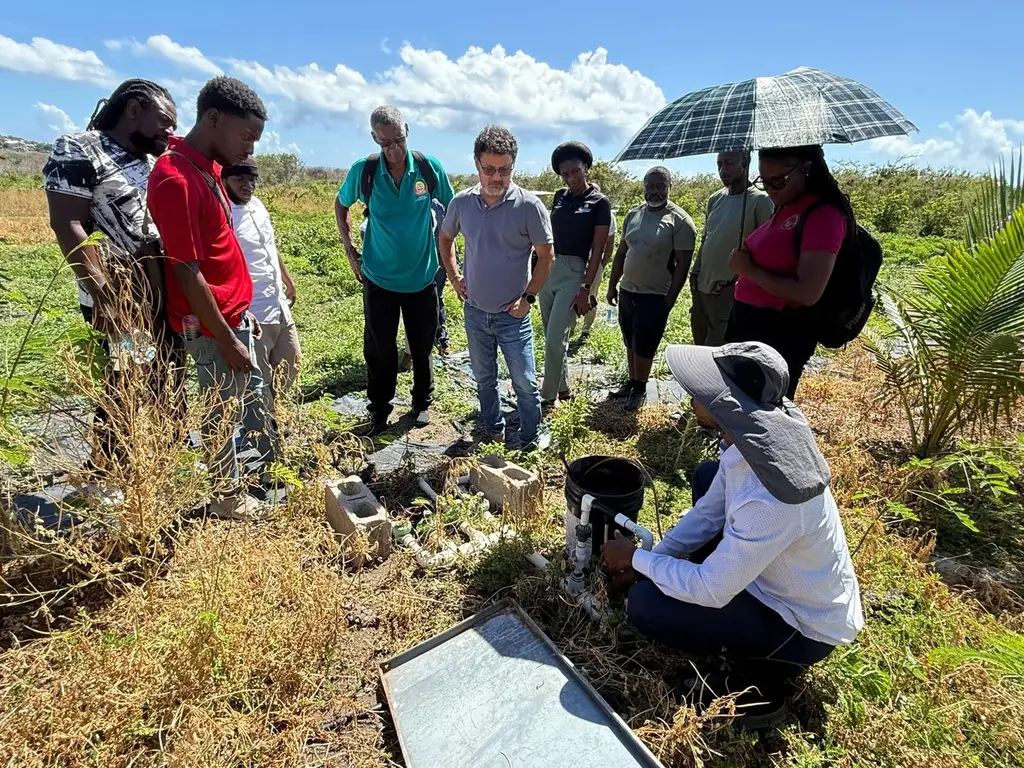
The afternoon session moved to an active farm in Conaree, where participants prepared fertilizer mixtures and nutrient solutions and practiced the use of a Venturi injector for fertigation. This hands-on field exercise enabled participants to apply the calculations and concepts covered during the classroom session under actual production conditions.
Denise Gillard, owner of Ever Green Farm in St. Kitts, highlighted the practical value of the training. “The workshop was very useful. I learned a lot about fertigation, including how to properly mix fertilizers, and I intend to put what I learned into practice on my farm,” she said.
The training on integrated crop management broadened the focus to the management of protected cultivation systems. Participants examined greenhouse microclimate management, including temperature, humidity and radiation; ventilation and shading strategies; and the selection and performance of covering materials. The training also addressed quality seedling production and nursery management, crop establishment, drip irrigation and fertigation, and plant nutrition.
A practical field session allowed participants to assess greenhouse setup and crop-production practices, identify good practices and production constraints, observe nursery and planting practices, and sanitation measures. Participants also discussed practical improvements that could be introduced within their own production systems.
Akiesha Fergus, owner of Lion Pride Farm in Nevis, said the training sessions provided knowledge she could apply directly to her production system. “The training was very beneficial. I learned how to better manage fertilizer use, water and greenhouse conditions, and I can already see how this information can help me improve crop performance, reduce unnecessary costs and manage my farm more effectively,” she said.
Anne Desrochers, FAO Plant Production and Protection Specialist and Lead Technical Officer for the project, highlighted the importance of applying technical concepts to farm-level decision-making. “Participants were highly engaged in the calculations, field observations and practical exercises, reflecting the strong demand for applied technical guidance. Building these skills is essential for improving nutrient, water and crop management and, ultimately, farm productivity,” she said.
The trainings form part of a broader collaboration between FAO and the Ministry of Agriculture, Fisheries and Marine Resources to strengthen protected and open-field vegetable production in Saint Kitts and Nevis through improved technologies, agricultural inputs and equipment and sustainable production practices. The project combines technical training with demonstration sites established on farms across both islands to support the practical adoption of improved production systems and more efficient management of water, nutrients and other agricultural inputs.
The activities were delivered as part of an FAO technical mission to Saint Kitts and Nevis from 21 to 25 September 2026, which provided broader technical support for project implementation. The mission included planning for the distribution and effective use of agricultural inputs, ensuring that baseline and follow-up information is collected from the field to measure changes in production practices and performance, reviewing digital tools to be installed and used on farms, strategic meetings to advance key implementation actions, and direct support to beneficiary farmers for the on-farm optimization of cultivation systems.