New GEF-funded, FAO-supported initiative will equip farmers with climate information, modern technologies and financing to strengthen food production, protect livelihoods and build a more resilient agricultural sector
Bridgetown, Barbados, 29 October 2026 – As droughts intensify, temperatures rise and water resources come under increasing pressure, Barbados is stepping up efforts to safeguard its agricultural future through a USD 3.5 million investment in climate-resilient food production.
The Government of Barbados, in partnership with the Food and Agriculture Organization of the United Nations (FAO) and with financing from the Global Environment Facility (GEF), officially launched the Barbados Accelerating Transition to Resilient Agrifood Systems (BATRAS) project on 28 October 2026. The four-year initiative aims to strengthen the resilience of agricultural production systems to climate change, improve productivity and enhance farmers’ livelihoods while contributing to national food security.
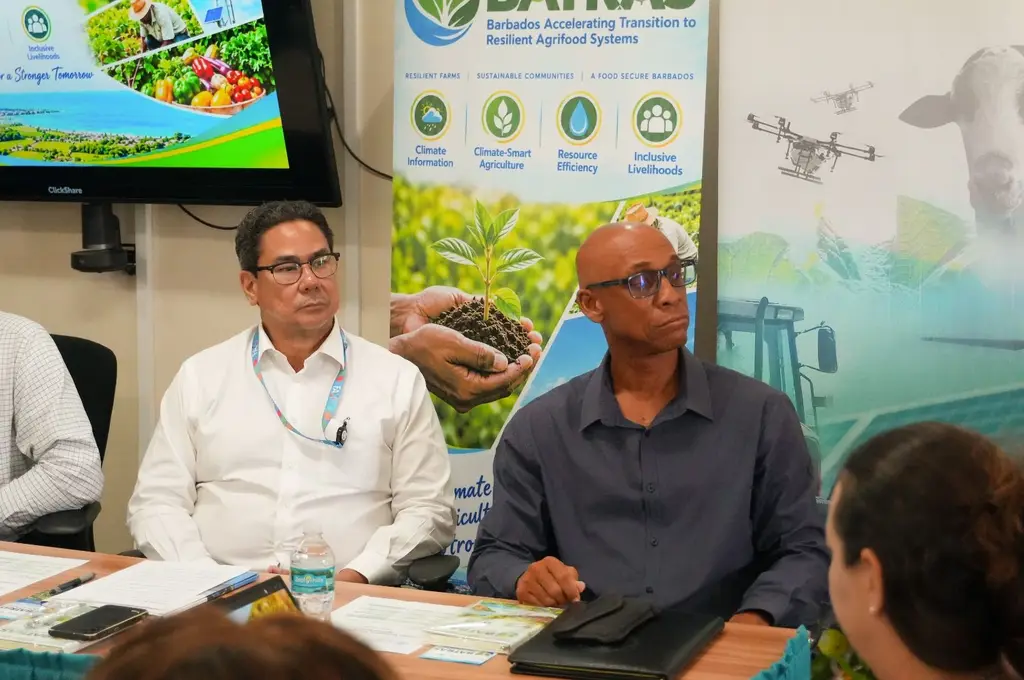
The launch attracted a full house of an estimated 50 stakeholders at the Ministry of Agriculture, Food and Nutritional Security, with strong participation from government representatives, agricultural institutions, technical partners and farmers. The turnout demonstrated the importance placed on strengthening climate resilience and securing the future of agricultural production in Barbados.
Backed by approximately USD 3.5 million in grant financing from GEF, BATRAS represents a significant four-year investment in the future of Barbados' agricultural sector. While FAO will provide technical oversight and expertise, The Barbados Agricultural Development and Marketing Corporation (BADMC) will lead project execution under the strategic direction of the Ministry of Agriculture, Food and Nutritional Security.
The project will tackle some of the sector's most pressing challenges through three strategic interventions: improving farmers' access to climate information to guide agricultural planning and decision-making; introducing practical climate-smart technologies and sustainable production techniques; and expanding access to financing, including matching grants, to help farmers adopt solutions that strengthen productivity and resilience.
Through farmer field schools and on-farm demonstrations, at least 400 farmers with women accounting for 40 percent of participants, are expected to receive training in climate-resilient agricultural practices. The project will also strengthen national extension capacities and promote improved irrigation, soil and water management, and agricultural technologies adapted to local production conditions.
In her official welcome, the Honorable Dr. Shantal Munro-Knight, Minister of Agriculture, Food and Nutritional Security underscored the importance of an inclusive agriculture sector for resilience.
“I am happy to see that this project will cater to women, young farmers, and the disabled. I see the very strong gender dynamics in this project and the targets in relation to women's participation again are welcome”, she stated.
Meanwhile, in his opening remarks, Mr. Juan Cheaz Pelaez, FAO Representative for Barbados (a.i.), emphasized the importance of linking national investments in water security with the knowledge, technologies and financing required to improve agricultural production.
“Water availability alone does not guarantee agricultural transformation. Farmers also need knowledge, technologies, financing and institutional support to use water efficiently and productively,” he highlighted.
The project’s gender assessment further highlighted the inequalities that must be addressed to ensure a more inclusive agricultural transformation. While women operate approximately 39 percent of agricultural holdings in Barbados, these account for just 6 percent of the country’s agricultural land. This disparity reflects persistent barriers to women’s participation and growth in the sector, particularly their limited access to land, financing, equipment and technical training. Young people also face challenges in accessing the resources, skills and opportunities needed to enter agriculture, establish viable enterprises and build sustainable livelihoods.
Through its Gender Action Plan, BATRAS will seek to address these inequalities by promoting more equitable access to training, climate-smart technologies, financing and other project-supported opportunities. Importantly, the project will also monitor whether these interventions translate into tangible improvements in agricultural productivity, economic opportunities and livelihoods for the intended beneficiaries.
During the launch, the BATRAS Project Coordinator, Mr. Dwayne Squires provided an overview of the BATRAS project, outlining its objectives and planned interventions, while farmer Ms. Peggy Scott brought the discussion to life by sharing firsthand experiences and practical examples of the challenges farmers face in the sector. In her closing remarks, Ms. Anne Desrochers, FAO Plant Production and Protection Specialist and Lead Technical Officer for BATRAS, emphasized that the project’s success will ultimately depend on the benefits delivered to farmers.