/ Sep 03, 2026
Trending
Emonews
Mr. Speaker,
Thankful to the Almighty God for His continued protection, guidance and blessings upon our nation, I greet the members of this Honourable House, invited guests, the people of Dominica and all those listening here and abroad, as I present this Fiscal Year’s Budget.
Mr. Speaker, I am grateful for the hardworking people the Lord has entrusted with the task of building this country. Our farmers, fishers and agro-processors; our public officers, police officers, teachers, nurses, doctors and sanitation workers; our tradespeople, entrepreneurs, bus and taxi drivers; our entertainers and athletes; our students and many volunteers have all played an important role in the remarkable progress our nation continues to make.
Every Budget presents an opportunity to account for our stewardship while we respond to the needs of our people and continue to advance the work of national development.
However, there are moments when changing circumstances demand a broader statement of direction. Such a statement must look beyond the immediate financial year. It must measure the distance we have travelled, identify the risks ahead and prepare the country to seize opportunities that may come only once in a lifetime.
We find ourselves at such a moment.
The world beyond our shores is being reordered in real time. Geopolitical tensions have disrupted energy markets and shipping routes. A new generation of trade barriers are emerging. Technology is changing the nature of work. Climatic events are increasing in frequency and severity. Competition for investment, talent and market access has intensified. Meanwhile, larger states and international institutions continue to revise the rules governing mobility, finance and international cooperation.
Mr. Speaker, for small island developing states, global events quickly become local realities.
We feel the consequences when fuel prices rise. We feel them when a container ship costs more to move. We feel them when imported food becomes more expensive. We feel them when international uncertainty reaches the shop counter in Bioche, Capuchin, Morne Prosper, Delices, Sineku, Gallion, Tranto, Tete Morne or any other community in Dominica. We feel them when the international community changes a rule and expects a small state, like Dominica, to absorb the consequences without being given the time and space to adjust.
Mr. Speaker, these realities make one thing abundantly clear: standing still is not an option. Countries that fail to prepare will find themselves increasingly vulnerable to forces beyond their control.
That is why Government has pursued a deliberate strategy of investment and transformation. Today, it is important to recognise how far we have already come. Dominica is no longer standing where it stood after Hurricane Maria. We are not standing where we stood when the pandemic closed the world. We have rebuilt homes, roads, schools and health facilities. We have protected incomes. We have expanded social support. We have pursued energy independence. We have opened new possibilities in tourism, agriculture, the blue economy and digital services. We have advanced projects that earlier generations discussed but could not bring within reach.
We have made measurable progress. But these advancements have not rendered us blind to the pressure being carried by households. We recognise the anxiety created by the cost of food, transportation, rent and construction.
A serious Government must be able to hold both truths at the same time. We must be proud of what has been achieved without suggesting that every problem has been solved. We must defend our record without becoming defensive. We must acknowledge pressure without surrendering confidence.
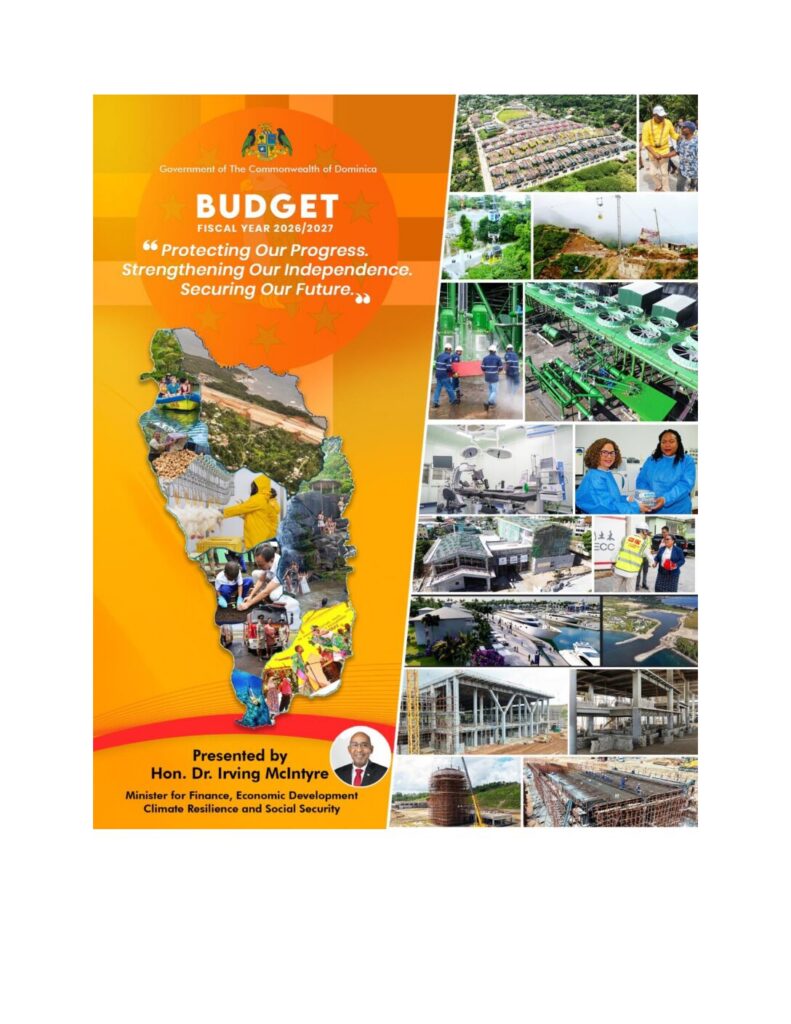
It is from this national position—our progress, our exposure, our assets and our responsibilities—that the theme of this Budget arises: Protecting Our Progress. Strengthening Our Independence and Securing Our Future.
These are not three disconnected phrases. They are one single governing philosophy. They describe the sequence by which a responsible Government should act: protect the gains for which our people have already paid and sacrificed; strengthen the country’s ability to stand on its own feet; and secure families against risks that may arrive without warning.
By protecting our progress, we are safeguarding what the Dominican people have built: our homes, our businesses, our schools, our health system, our roads, our communities, our social protections, our international relationships and our fiscal stability.
To Strengthen our independence, we are called to produce more of what we consume, generate more of our own energy, increase foreign exchange from several sectors, continue to develop Dominican enterprise, and ensure that no single programme, market or external institution can determine the limits of our future.
In securing our future, we must continue to prepare our people for the jobs of tomorrow, protect the vulnerable, manage our resources responsibly, strengthen institutions and build resilience into every layer of national life.
These three principles set the foundation on which this Year’s Budget has been prepared. And so, I begin with the macroeconomic performance and outlook for Dominica.
MACROECONOMIC PERFORMANCE AND OUTLOOK
Mr. Speaker, the performance of our economy shows that the strategy we have pursued is producing results and giving the country greater room to protect essential services and prepare for future shocks.
The Macroeconomic Performance
According to the International Monetary Fund’s (IMF) July 2026 publication of the World Economic Outlook, global growth in 2025 is estimated at 3.5 percent while the Eastern Caribbean Central Bank indicated a 3.0 percent growth for the Eastern Caribbean Currency Union (ECCU) during that same period.
However, Mr. Speaker, Dominica’s economic performance in 2025 exceeded both the global and ECCU averages. Building on the 3.5 percent which was achieved in 2024, Dominica achieved growth of 4.5 percent in 2025—that is, 1.5 percent above the ECCU and global averages. This strong performance was driven by an 18.3 percent increase in visitor arrivals alongside expansion in the construction, retail, and trade sectors.
Driven by oil-price shocks and trade-policy uncertainty, global inflation averaged 4.1 percent in 2025, while inflation within the ECCU stood at 2.5 percent. Inflation in Dominica was below average at 2.3 percent, easing from 3.1 percent in the previous year as prices of imported goods softened. The current-account deficit was elevated in 2025 at 38.0 percent of GDP, largely because work accelerated on transformative projects—including the International Airport, the Geothermal Plant and transmission infrastructure, the Cable Car, the Marina and the Loubiere to Bagatelle Road—resulting in higher investment
related imports. As at 30 June 2026, the debt-to-GDP ratio stood at 99.5 percent.
Mr. Speaker, Government’s fiscal balance has improved with a primary surplus of 1.8 percent for fiscal year 2025/2026, that is, 0.8 percent higher than projected. This positive performance was driven mainly by a 7.6 percent growth in tax revenues.
The Macroeconomic Outlook
As we forge ahead, the IMF projects that Dominica’s economy will expand by a further 3.1 percent in 2026—that is, 0.1 percent above the 3.0 percent forecasted for global and ECCU economies. Inflation is projected to average 3.0 percent before easing towards its long-term norm of 2.2 percent by 2028.
Total revenue for Fiscal Year 2026/2027 is estimated as follows:
| REVENUE | 2026/2027 Millions |
| Tax Revenue | 473.53 |
| Non-Tax Revenue | 558.57 |
| Total Recurrent Revenue | 1,032.10 |
| Capital Revenue | 10.00 |
| Grants | 117.55 |
| Total | 1,159.65 |
Government intends to use continued growth, stronger revenue and greater public service efficiency to improve the fiscal position, raise disposable income and reduce business costs. From 2026/2027, Government commits to an annual primary surplus of at least 2.0 percent of GDP until the debt-to-GDP ratio declines to 60 percent; the current Estimates project a surplus of 2.2 percent. That discipline preserves room to maintain essential services and respond to future shocks.
Mr. Speaker, risks to the economic outlook remain significantly elevated. The persistence of extreme weather events over time continues to threaten projected economic gains, while the ongoing conflict in the Middle East, a major oil-producing region, continues to place upward pressure on global energy prices with consequential impact on food and other commodity prices.
On the upside, our goal to transition to 100 percent renewable electricity generation by 2030 will reduce exposure to volatile oil markets. Digitisation of government service, improved connectivity and a more diverse tourism product will also strengthen public services and support wider economic activity.
Additionally, strengthening technical and vocational education will help close critical skill gaps in construction, manufacturing and tourism, thereby improving productivity and expanding economic output.
In 2026/2027, we will advance this agenda through prudent fiscal management, efficient expenditure, implementation of a robust revenue arrears collections framework and productive investments—the capacity to protect our progress, strengthen our independence and secure our future.
These figures establish the fiscal setting. The Budget now turns them into choices about what must be kept running today and what must be built for tomorrow. I therefore present the Budget Proposal for Fiscal Year 2026/2027, totalling EC$1.24 billion.
FISCAL YEAR 2026/2027 BUDGET PROPOSAL
Recurrent Expenditure
Mr. Speaker, I propose a total recurrent expenditure of EC$675.1 million for Fiscal Year 2026/2027. It covers legally mandated expenditure and those required for the day-to-day operation of the State. For example, payment of public-service salaries, utilities, and rent, the procurement of supplies and equipment, maintaining our roads, and operating our education, health, national security and justice systems.
Mr. Speaker, Table 1 outlines the details of this proposed recurrent expenditure. Table 1: Recurrent Expenditure by Ministry/Department
Ministry/Department
Amount (000’s m)
%
Office of the President 1.6 0.2% Integrity in Public Office 0.5 0.1% Public and Police Service Commission 0.5 0.1% Legislature 1.3 0.2% Audit Department 1.2 0.2% National Security and Legal Affairs 67.1 9.9% Elections 1.7 0.3% Office of the Prime Minister 8.4 1.2% Finance, Economic Development, Climate Resilience and Social
Security 284.8 42.2% Agriculture, Fisheries, Blue and Green Economy 9.2 1.4% Education, Human Resource Planning, Vocational Training and
National Excellence 76.9 11.4% Housing and Urban Development 5.9 0.9% Health, Wellness and Social Services 75.4 11.2% Environment, Rural Modernisation, Kalinago Upliftment and
Constituency Empowerment 10.2 1.5% Tourism 27.1 4.0% Culture, Youth, Sports and Community Development 15.1 2.2% Establishment, Personnel and Training Department 10.1 1.5% Public Works, Public Utilities and the Digital Economy 52.2 7.7% Foreign Affairs, International Business, Trade and Energy 19.7 2.9% Cabinet Office 3.5 0.5% Labour, Public Service Reform,Social Partnership,Entrepreneurship
and Small Business Development 2.7 0.4%
GRAND TOTAL 675.1 100.0%
A total of 42.2 percent of recurrent expenditure, or $284.8 million, is allocated to the Ministry of Finance, Economic Development, Climate Resilience and Social Security.
Of this amount, $122.2 million is allocated for debt-service payments; $47.3 million for gratuities and pensions to retired public officers; $75.2 million for marketing and due diligence services for the Citizenship by Investment Programme; and $10.2 million for insurance coverage, including disaster-risk insurance.
The Ministry of Education, Human Resource Planning, Vocational Training and National Excellence receives the second-largest allocation, $76.9 million, or 11.4 percent of total recurrent expenditure. It will fund teachers’ salaries, school operations, student transportation, uniforms and school-feeding programmes—services that support learning while easing costs on parents. These are not figures in a vacuum, they represent yet another demonstration of this Government’s commitment to education as a key driver of national development.
allocation of $75.4 million, or 11.2 percent of total recurrent expenditure. This will ensure The Ministry of Health, Wellness and Social Services will receive the third-largest
a sustained access to healthcare by funding the procurement of medicines, continued engagement of health workers and operation of the hospitals and other medical facilities.
Additionally, $67.1 million, or 9.9 percent of total recurrent expenditure, is allocated to the Ministry of National Security and Legal Affairs. Public safety, border protection, law enforcement and the administration of justice, are not buzz words for this Government. The safety of Dominicans matter.
The Ministry of Public Works, Public Utilities and the Digital Economy will receive $52.2 million, or 7.7 percent of total recurrent expenditure, to fund road and infrastructure maintenance, utilities and digital services.
Table 2: Recurrent Expenditure by Economic Classification (EC$ millions)
Classification Estimate FY
%
2026/2027
Personal Emoluments 184.4 27%
Goods & Services 225.2 33%
Transfers and Subsidies 137.1 21%
Refunds 5.0 0%
Investment Financing 1.2 0%
Sub-Total 552.9 81%
Interest 48.6 7%
Debt Amortization & Sinking Fund 73.6 12%
Total 675.1 100%
Mr. Speaker, overall, financing the procurement of goods and services is the single largest expenditure item within the recurrent expenditure budget totalling $225.2 million. This is followed by personal emoluments which is projected at $184.4 million and include the 3 percent salary increase for public officers in 2026/2027. Transfers and subsidies are estimated at $137.1 million and cover retirement benefits, the subvention to the Dominica China Friendship Hospital and other statutory bodies, other obligations, grants to various institutions, and public assistance. Interest payments are estimated at $48.6 million, with debt amortisation and contributions to the sinking fund projected at $73.6 million.
I now turn to the Capital investment which our Government is making to ensure sustainable growth of this country.
Capital Expenditure
Mr. Speaker, the Capital Estimates, comprising Government’s Public Sector Investment Programme for Fiscal Year 2026/2027, propose total capital expenditure of $566.9 million. $117.6 million in grants.
It will be financed through $383.5 million in local resources, $65.8 million in loans and
Table 3 details the allocations by Ministry and Department. These investments build the infrastructure and productive assets needed to expand economic capacity and resilience. Through these initiatives, this Government aims to strengthen our productive capacity,
promote inclusive growth, and enhance the quality of life for all. Ministry/Department
Table 3: Capital Expenditure by Ministry/Department
Amount
(000’s m)%
Office of the President 2.3 0.4% National Security and Legal Affairs 2.5 0.4% Elections 1.5 0.3% Office of the Prime Minister 290.0 51.2% Finance, Economic Development, Climate Resilience and Social
Security 11.9 2.1% Agriculture, Fisheries, Blue and Green Economy 25.4 4.5% Education, Human Resource Planning, Vocational Training and National Excellence 5.9 1.0% Housing and Urban Development 19.8 3.5% Health, Wellness and Social Services 5.1 0.9% Environment, Rural Modernisation, Kalinago Upliftment and
Constituency Empowerment 57.1 10.1% Tourism 6.3 1.1% Culture, Youth, Sports and Community Development 13.6 2.4% Establishment, Personnel and Training Department 0.2 0.0% Public Works, Public Utilities and the Digital Economy 70.7 12.5% Foreign Affairs, International Business, Trade and Energy 51.7 9.1% Cabinet Office 0.5 0.1% Labour, Public Service Reform,Social Partnership,Entrepreneurship and
Small Business Development 2.4 0.4%
GRAND TOTAL 566.9 100.0%
A total of $290 million has been allocated to the Office of the Prime Minister for the continued development of the International Airport and the Marina. Of this amount, $250 million is allocated to the International Airport Project and $40 million to the Marina Development Project.
With an allocation of $70.7 million, the Ministry of Public Works and the Digital Economy will advance roads, water and sanitation and the Digital Economy—supporting safer access, more reliable public utilities and easier access to Government services.
The Ministry of Environment, Rural Modernisation, Kalinago Upliftment and Constituency Empowerment has been allocated $57.1 million, primarily to finance the Kalinago Multipurpose Centre and Emergency Shelter, environmental sustainability initiatives— including sustainable waste management—and the National Employment Programme.
The Ministry of Foreign Affairs, International Business, Trade and Energy has the fourth grid.
largest allocation in the amount of EC$51.7 million of which EC$51.2 million will fund the remaining work on the new network to transmit the geothermal and hydro power to the
The Ministry of Agriculture, Fisheries, Blue and Green Economy has been allocated EC$25.4 million to advance food security, economic resilience and sustainable livelihoods through a comprehensive suite of programmes and initiatives.
An allocation of EC$19.8 million is provisioned for the Ministry of Housing and Urban Development to include expenditure related to the Roseau Enhancement Project and Government’s comprehensive housing programme.
Mr. Speaker, this $566.9 million in investments are expected to enhance the lives and livelihood of Dominicans across the country. These investments will create short term and long-term jobs; increase family income and open new opportunities for businesses. They will strengthen food security, improve roads, water supply and make daily life more conducive for residents. They will also make Dominica even more attractive to visitors, improve connectivity to the island, increase exports, stimulate economic growth, and continue the transformation of our country.
I will now inform the Honourable House and the people of Dominica of the progress we have made, the progress we must protect, and the progress we are building on.
PROTECTING OUR PROGRESS
Mr. Speaker, before we turn to projects, programmes or sectors, we must begin with the most fundamental issue of all: the contract between a Government and the people it serves. A Budget is more than a statement of expenditure; it is an expression of priorities, responsibility and trust. It reveals what a Government is prepared to protect, what it is determined to change and how seriously it takes the everyday concerns of its citizens.
Government is entrusted with more than a mandate. It is entrusted with the people’s confidence. Dominicans expect Government to plan wisely, spend responsibly, protect the vulnerable and create conditions in which the people’s effort can be rewarded and citizens can grow. They expect leadership to be present when it matters—when a family loses a home, when a farmer loses a crop, when a vulnerable person requires care and when a community faces danger.
This Government has honour that covenant.
The evidence is not in what Government says about itself. It is in the record that follows: homes completed, schools built, health services expanded, incomes placed in communities, and citizens protected. These achievements, which we must protect, form the first pillar of this Budget, that is, the social development of our people.
SOCIAL DEVELOPMENT
Housing and Home Ownership
Mr. Speaker, there are responsibilities that fall squarely within the remit of Government, and there are others that Government assumes because of a deeper sense of duty and
commitment to its people. This Administration has never held the view that our mandate ends with the provision of services legally required of us. We know that we must also create conditions that allow families to build security, accumulate wealth and improve their quality of life.
Bearing this mind, we have gone beyond the traditional role of Government to assist families—including middle-income families—in securing land, building homes and achieving greater economic stability.
Mr. Speaker, I am pleased to report that Government commenced the procurement process for the East Communities and Campbell Relocation Housing Projects which will add to the more than 3,000 resilient housing units constructed across Dominica.
Efforts to expand home ownership also advanced through the allocation of ninety-nine residential lots at substantially reduced prices in Warner, Jimmit, Hillsborough Garden, Cotton Hill, Grand Bay and Plat Ma Pierre. Mr. Speaker, lots valued at $10.00 and $12.00 per square foot were sold to our young people as low as $5.00 per square foot. These significant discounts have resulted in major savings for our young people who now have
the opportunity to build homes of their own.
Government also advanced reforms to modernise land administration, strengthen survey and planning systems, and ensure that future development is orderly, sustainable and responsive to the needs of a growing nation.
Mr. Speaker, home ownership must be supported not only by access to land, but also by affordable financing. Government is therefore proceeding with the Opportunity Knocks 2% Housing Programme announced in the previous cycle for public officers and members of the Commonwealth of Dominica Police Force. Some applications have already been approved and others are under consideration. The benefit of concessionary financing is straightforward: it lowers borrowing costs, reduces the monthly instalment payment and permits the borrower more disposable income during the life of the loan or alternatively, allows the borrower to increase the size of his mortgage or home. For a working family, that can make homeownership more affordable—turning a recurring rental expense into an investment in a lasting family asset.
Mr. Speaker, the true value of owning a house is not found in the cost of concrete and steel. It is found in the improvement of the life of a family.
It is the mother who no longer fears when the hurricane season begins. It is the elderly person who has moved from insecurity into dignity. It is the child who can study in a safer environment. It is the family that can redirect income originally used to pay rent, toward food, education and advancement.
Every completed home represents a family and community made safer and wealthier.
A secure home protects a family, but the future of that household also depends on whether its children can gain the knowledge and skills to earn, compete and achieve. So, the next protection we strengthen is education.
Education and Human Capital
Mr. Speaker, Nelson Mandela reminded us that “no country can really develop unless its citizens are educated.” This Government shares that conviction. Education is not merely a social service; it is the foundation of opportunity, productivity and national progress. A country that educates its people equips them to create, innovate, and compete, thereby shaping their own future.
Government is investing heavily in educational infrastructure across the country. The Government of the People’s Republic of China funded Goodwill Secondary School, Calibishie Primary School and Thibaud Primary School are 90 percent complete while the Tete Morne, Bellevue Chopin and Sineku schools are 85 percent complete.
These projects have created work for more than 140 Dominicans. But the lasting value will be measured by the children who learn in modern classrooms, the teachers better equipped to teach and the young people who discover that intelligence is expressed not only through examinations, but through technical skills, creativity, problem-solving and enterprise.
Mr. Speaker, we have held firm to the view that education is the greatest equaliser in any society. A child’s opportunity to learn, to develop their talents and to build a better future should never depend on the financial circumstances of their parents. So, this Government has made it a priority not only to invest in schools and teachers, but also to remove the financial barriers that prevent children from accessing education.
Accordingly, during the last fiscal year, Government invested more than $22.8 million in programmes that directly supported students, families and educational institutions. These investments provided transportation for primary and secondary school students, subventions for the Dominica State College, salary grants to non-government primary and secondary schools, salary support to early childhood centres, the School Feeding Programme, the Textbook Programme, school transfer grants, and the Uniform Assistance Programme.
Mr. Speaker, these allocations represent a conscious decision that no Dominican child should: (i) miss school because transportation is unaffordable; (ii) go without a nutritious meal during the school day; (iii) lack a textbook or uniform; or (iv) be denied an education because a family cannot meet the associated costs.
Again, Mr. Speaker, the monies invested in education are not disconnected statistics. They describe the social character of this Government. They reveal who we place at the centre of our decision making. They show that national progress has a human face.
Government continues to invest heavily in tertiary education through free tuition at the Dominica State College; ongoing scholarship programmes with our long-standing partners in China, Cuba and Morocco; and a range of financial assistance initiatives that expand access to higher education. Three hundred and forty-three (343) students graduated from the Dominica State College just this past month. They represent 343 stories of possibility and 343 reminders that when Government invests in education, it is investing in the future of our country.
In the upcoming academic year, ten Dominican students will receive newly secured scholarships to the University of Guyana, while five additional scholarships have been secured for study in Romania in priority fields aligned with our national development agenda, including aviation and other disciplines that support the country’s strategic transformation.
Government is also finalising additional financing of $19.0 million from the Caribbean Development Bank through the AID Bank to expand student loan assistance, enabling more Dominican students to pursue tertiary education and professional training. Special focus will be given to students pursing studies in accordance with a revised national priority list and skills training.
Mr. Speaker, we are also transforming what our children learn to prepare them to drive the “new-look” Dominica which is developing before us. Curriculum reform will focus on developing the analytical, critical thinking, innovative and entrepreneurship skills of our children and young people. It will strengthen science, technology, technical and vocational education, entrepreneurship, digital literacy, creativity, civic responsibility and problem
solving. This is how education moves from social protection to economic independence: by preparing young Dominicans to fill the jobs being created in construction, aviation, tourism, energy, agriculture, manufacturing and digital services.
Education gives a household the capacity to advance; health protects that capacity from being lost to illness, distance or unaffordable care. I therefore turn to the health and social systems that stand between a medical emergency and a family crisis.
Healthcare and Social Protection
Mr. Speaker, protecting our progress means protecting the health of our people. It means ensuring that the investments we have made over the years deliver better healthcare, stronger institutions and improved outcomes for every Dominican.
Building on the construction of the Dominica China Friendship Hospital, the Marigot Hospital and the thirteen Health and Wellness Centres, we are improving healthcare services across the island. SMART upgrades were completed at the Mahaut, Castle Bruce and Wesley Health Centres, making these facilities more resilient. Rehabilitation works were also completed at the San Sauveur, Mahaut River and Belles Health Centres, while the new Savanne Paille Health and Wellness Centre is now operational, restoring primary healthcare services to that community.
Mr. Speaker, our primary healthcare system has long been recognised as one of the strongest in the region. By modernising facilities and expanding services, we are protecting that achievement and bringing quality care closer to the people. Care delivered closer to home can mean one less costly trip to Roseau, less time away from work, faster attention and earlier treatment before a manageable condition becomes a household emergency.
At the Dominica China Friendship Hospital, a new Accident and Emergency Operating Theatre was commissioned, significantly expanding emergency surgical capacity, reducing response time and improving patient outcomes for critically ill and injured patients.
Government is implementing a new human resource management structure across the healthcare system to strengthen leadership, improve service delivery and enhance patient care. As part of this reform, positions are being filled in the new nursing management structure while additional medical specialists are being appointed to improve the quality of services and expand access to specialised care.
Protecting our progress also requires strong institutions and modern regulatory frameworks. The Medical Profession Act, the Nurses and Midwives Act and legislation establishing the Medical Laboratories Council have been enacted. These measures will strengthen professional standards, improve regulation and accountability, support the recruitment and retention of qualified healthcare professionals and ensure that the healthcare system meets the highest standards of safety and quality.
Our healthcare system continues to reach important milestones. The successful completion of Dominica’s first brain tumour surgery is a clear demonstration of the growing capacity of our health services. Today, major procedures that once required patients to travel overseas are increasingly being performed here at home, supported by a growing team of specialist consultants and improved diagnostic and surgical capabilities.
Mr. Speaker, Government is committed to ensuring that patients receive high-quality clinical care and the support they need throughout their healthcare journey. To further strengthen patient care, we are establishing a Patient Support Unit, staffed by dedicated Patient Navigators who will help patients access services, coordinate appointments and receive guidance from diagnosis through treatment.
Mr. Speaker, protecting progress also means protecting dignity.
From its very beginning, one of the defining principles of this Dominica Labour Party government has been that development must improve the lives of every citizen, especially those who are least able to help themselves. Caring for the elderly, persons living with disabilities, vulnerable families and those facing hardship has never been an afterthought. It has been, and continues to be, a fundamental pillar of this Government’s philosophy and a defining feature of our approach to national development.
Even as global economic uncertainty, inflation and other external pressures place demands on public finances, this Government has remained steadfast in protecting the social programmes that thousands of Dominicans depend upon. We have made a deliberate decision that, regardless of the challenges we face, we will continue to invest in people because no society can truly progress if its most vulnerable citizens are left behind.
Throughout the past year, Government continued to provide for our elderly citizens, persons living with disabilities and vulnerable families through the Public Assistance Programme, the Yes We Care Programme, Social Welfare services, the Non-Contributory Pension for persons over the age of sixty-five, and a range of community-based support initiatives that help improve the quality of life for many households across the country.
Mr. Speaker, we also recognise that people living with disabilities must be active participants in national development. In 2022, in response to the advocacy of the Dominica Association of Persons with Disabilities (DAPD), Government established the National Commission on Persons with Disabilities. Building on that important step, Government will now establish a dedicated National Disability Affairs Unit, headed by a Coordinator, to give greater focus and prominence to issues affecting persons with disabilities. This Unit will support the Commission in fulfilling its mandate, strengthen advocacy, improve coordination across ministries and agencies, and ensure that the rights, needs and interests of persons with disabilities receive sustained attention at the national level.
Mr. Speaker, these programmes reflect a simple but enduring principle—development must never leave people behind. Public assistance, pensions and disability support protect our most vulnerable citizens, preserve dignity and provide support when it is needed most. That is protection in its most human form—ensuring that age, disability or misfortune does not erase a person’s place in the national community.
Sports, Community Life and Opportunity
Mr. Speaker, this government is also investing in the facilities, programmes and environments that allow our young people to develop their talents and realise their full potential.
Government has made significant investments in sports infrastructure across Dominica. I am excited to report that we now have an upgraded and modernized lighting system at the Windsor Park Sports Stadium, which allows us to resume night sporting events, expand community access and improve training opportunities for athletes. Work is set to begin this year on the Synthetic Track and Field Facility at Pointe Ronde, another transformative investment that will strengthen athletics development and provide world
class facilities for our aspiring athletes.
Community sporting facilities continue to be enhanced throughout the island, including the lighting of several sports facilities and the completion of the Trafalgar Basketball
Court. For our young people, a public sporting facility provides access, supports health and discipline and can open a pathway from community participation to national representation and employment in sport.
Investing in Playgrounds and Community Spaces
Mr. Speaker, strong communities are built not only through houses and roads, but through the shared spaces that bring people together. Safe, attractive and well-maintained recreational areas give children room to play, families places to gather and neighbours opportunities to strengthen the bonds that keep communities healthy, secure and vibrant.
Government will therefore continue its programme to develop and upgrade playgrounds and green spaces in rural communities across Dominica. This initiative recognises that every child, regardless of where he or she lives, should have access to safe and well maintained recreational spaces that encourage healthy growth, physical activity and social interaction with extended family and community.
The programme will provide modern playground equipment, green landscaped areas, seating, walking paths where appropriate, lighting and other amenities that create welcoming spaces for children, families and senior citizens. Communities will also be encouraged to incorporate native trees and plants, reinforcing our commitment to environmental stewardship while enhancing the beauty of our villages.
Government will work closely with Village Councils, community organisations, youth groups and the private sector to identify suitable locations and keep these facilities maintained.
Facilities create the space for development; people provide the knowledge that turns potential into capability. We will therefore connect community infrastructure with the experience already present among our own citizens.
Community Mentorship Programme
Mr. Speaker, the wealth of a nation is measured not only by what lies beneath its soil or within its Treasury, but also by the knowledge, skills and experience carried by its people. Across Dominica is a deep reservoir of expertise—retired professionals, successful entrepreneurs, skilled artisans, farmers, tradespeople, educators, accountants and information technology specialists. That accumulated wisdom must not be allowed to retire from national development. It can mentor young people, strengthen emerging businesses, transfer practical skills and help the next generation advance with greater confidence.
Therefore, this year, in addition to our Youth Skills Training Programme, Government will establish a Community-based Mentorship Programme to facilitate practical training and hands-on support. The programme will connect experienced professionals and skilled community members with young people, aspiring entrepreneurs and others seeking to acquire new skills, improve existing ones or transform ideas into successful businesses.
Participants will benefit from practical instruction and mentoring in areas such as entrepreneurship, financial management, digital technology, agriculture, the trades, customer service, leadership and other disciplines aligned with community needs and national priorities.
Mr. Speaker, our aim is to create a cadre of new entrepreneurs, ready to embrace the opportunities which will be available in the ‘new look’ Dominica. As these new opportunities become available across the country, it is important to highlight that proper infrastructure and connectivity is required.
Infrastructure and Connectivity
Mr. Speaker, one of the defining achievements of this Government is the transformation of the road network across the country. Communities that were once difficult to reach are now better connected through modern roads and bridges, making it easier for people to get to work, take their produce to market, access healthcare and send their children to school. That is what development looks like in practical terms, and this Government has delivered in every part of the country.
Mr. Speaker that work continues. Most recently, the East Coast Road improved connectivity from Bois Diable to Hatton Garden through the Kalinago Territory and along the eastern corridor. The Loubiere to Grand Bay Road is well advanced with the construction of five new bridges, drainage improvements, road widening and reconstruction.
Government is also preparing for Phase II of the Roseau Enhancement Project, which is, the rehabilitation of seven streets. We are moving forward with stakeholder consultations and procurement activities. A contract for the commence of works should be awarded by December 2026 to allow works to begin by February 2027.
Other major road rehabilitation works planned to commence within the next two years include the Yorke Valley to Sultan Road, the Pond Case to Bois Diable Road, the North Road from Portsmouth to Hatton Garden and the resurfacing of the road from Roseau to Canefield.
Mr. Speaker, every road we have built, every school and hospital we have upgraded and every resilient home we have constructed helps to reduce vulnerability, increase opportunities and expand the choices available to Dominican families.
That record required resources, sound policy choices and the courage to invest for the long term while steering the country to recovery from extraordinary shocks. To explain honestly how our progress was protected, we must identify one of the principal instruments that helped finance it.
The Citizenship by Investment Programme
Mr. Speaker, any honest account of Dominica’s progress must acknowledge the contribution of the Citizenship by Investment Programme (CBI) and the prudent and visible use of those funds.
CBI has not been an abstract entry in the national accounts. It financed resilient housing, healthcare, education, agriculture, small business development, roads, climate-resilient infrastructure and projects that are creating the platform for future sustained growth. For the household, its contribution is therefore visible in assets and services that families use, in the jobs they have secured and the economic benefits their families have received, in a better quality of life, in reconstruction that did not have to be financed through heavier taxation, and in national capacity that would otherwise have taken far longer to build.
CBI has also supported the productive economy. Since this Government restructured the Programme in 2014, thousands of business owners, farmers and fishers received direct and indirect benefits. Investment through the approved real-estate route helped finance hotels and ecolodges, expanding Dominica’s tourism plant and creating construction and hospitality opportunities.
Mr. Speaker, it helped Dominica respond when disaster could have reversed a generation of progress. Hurricane Maria inflicted damage and loss estimated at 226 per cent of GDP. In the weeks and months that followed, accumulated CBI resources were mobilised to bridge urgent financing gaps while grants and other external support were being assembled. Those resources helped Government restore essential services and rebuild public infrastructure. Thousands of Dominicans, in every community, received CBI grants to restore their homes and others received new houses from government.
The International Monetary Fund has confirmed that the sharp increase in resilient public investment after Maria was financed mainly from CBI revenue. The World Bank has similarly reported that accumulated CBI reserves were drawn down to finance reconstruction and recovery activities. This did not replace the valuable support of international partners; it gave Dominica the capacity to act immediately and to direct resources to national priorities.
The Programme gave a small country room to act when the scale of our need exceeded the space available through ordinary revenue and borrowing. It allowed Government to move with urgency when delay would have imposed a greater human and economic cost.
Mr. Speaker, there should be no apology for homes built for Dominican families, for health facilities, schools, roads and resilient communities, or for building hotels and advancing our development, or for lawfully mobilising resources to protect our people.
But confidence in the programme and its benefits must never become complacency.
The value of Dominican citizenship must be guarded with seriousness. Due diligence must remain rigorous. Administration must continue to be sound. Oversight must continue
to be strong. Information sharing and international cooperation must continue. The integrity of the Programme is not separate from its economic value; integrity is the foundation of its economic value.
Mr. Speaker, international rules affecting investor-citizenship programmes and visa-free mobility are changing. Our response must be clear. We will continue to engage constructively with all our partners. We will listen to their concerns, adjust our systems, where required, and continue to uphold high standards.
The European Union has revised its visa-suspension framework, putting further pressure on investor-citizenship programmes. We do not dismiss that development or answer it with hostility. We will answer through constructive dialogue.
Dominica will approach these discussions as a responsible partner—prepared to cooperate, uphold high standards and protect the legitimate development interests of the Dominican people.
That is the position from which we move forward: confident in the contribution of CBI, firm in protecting its integrity and equally determined that no single programme will carry the full weight of our future. The assets CBI helped to build must now produce jobs, exports, energy savings and new income. That is the bridge from protecting our progress to strengthening our independence.
STRENGTHENING OUR INDEPENDENCE
Mr. Speaker, strengthening our independence does not mean turning away from CBI, international partners or foreign investment. It means ensuring that Dominica has options. It means that if one revenue source weakens, several productive sectors can continue to support jobs, public services and household income.
From the outset, Government’s purpose was clear: to convert CBI revenues into lasting national assets and productive capacity. Those resources helped build the infrastructure, resilience and social foundation on which the next stage of development can stand. CBI which helped us build those investments must now help us earn. This means turning infrastructure into enterprise, enterprise into employment and employment into stronger household incomes—while attracting visitors and more investments, increasing exports and generating new sources of national income that circulate through communities across Dominica.
That is why your Government has consistently pursued economic diversification. Mr. Speaker, long before recent international developments, we deliberately broadened the country’s productive base so that Dominica would be better positioned to withstand external shocks and create more long-term opportunities for its people.
Let me assure our people that this strategy will continue. We will build on the progress already made, strengthen productive sectors and widen the number of ways in which a Dominican can earn a living at home.
Agriculture, Food Security and Value Addition
Mr. Speaker, Agriculture!
Mr. Speaker, this government has invested heavily in transforming agriculture into a modern, competitive and commercially driven sector. From July 2017 to June 2026, Government invested EC$252.5 million in agriculture, livestock, fisheries, agricultural infrastructure and food security.
Over the last 12 months, approximately 830 acres of priority crops were established, with projected production of 17.9 million pounds of marketable produce valued at more than EC$44.7 million. Those figures represent potential farm income, more local food in shops and markets, and a larger domestic buffer when shipping or overseas supply is disrupted.
Mr. Speaker, Government’s strategy for transforming agriculture is equally focused on adding value to what we produce, expanding market access and creating greater economic returns for our farmers and agro-processors.
Over the past year, through DEXIA, Government purchased more than 938,000 pounds of agricultural produce, injecting almost EC$1.5 million directly into the hands of Dominican farmers. Government also invested more than EC$4 million to strengthen over 150 agro-processors, while providing EC$1 million to support the commercialisation of locally manufactured products.
The next logical step is to create the infrastructure that will enable agricultural products to be processed, branded and marketed on a commercial scale. To that end, Government has completed the feasibility study, architectural designs and cost estimates for the establishment of a multi-purpose agro-processing facility.
The facility will serve as the national hub for agro-processing, value addition and commercialisation. It will provide commercial-scale processing infrastructure for root crops and tropical fruits, while housing dedicated incubation space for entrepreneurs producing honey, sauces, jams and jellies, herbs, spices and other value-added agricultural products.
This investment will reduce post-harvest losses by creating reliable markets for fresh produce and enabling surpluses to become higher-value, shelf-stable products. For the farmer, that means less income rotting after harvest. For the consumer, it means a longer local selling season and more Dominican alternatives when imported products become scarce or expensive. For the entrepreneur, it creates room to turn a crop into a branded product with a higher return.
This year, more than 520 farmers and agro-processors will begin to receive support under the Dominica Community Resilience Enhancement Project (DOMCREP) to adopt
climate-smart agricultural practices, including improved irrigation, greenhouse technology and agroforestry. This investment will increase agricultural productivity and improve livelihoods in these communities.
Mr. Speaker, Government has also been investing in the rehabilitation of farm access roads to increase production. Since the Feeder Road Rehabilitation Programme resumed in 2021, eleven feeder roads have been completed at a cost of approximately $26 million, significantly improving access to agricultural lands, reducing transportation costs and enabling farmers to move inputs and produce more efficiently. During the past year, progress continued on feeder roads at Captain Bruce, Neiba/Atlee, Macaton, Carholme and Belles, while a contract was awarded for the rehabilitation of the Grange Road in Portsmouth. Further works will proceed this fiscal year on the O’Delice/Newfoundland Feeder Road and the Modest Feeder Road in Castle Bruce.
Mr. Speaker, Government has completed the new Abattoir for poultry and pork, while the National Feed Mill will soon be completed. These are intended to lower production constraints and support expanded domestic meat production. When local producers can access feed and processing more efficiently, the benefit is greater stability in supply, more income kept in farming communities and less exposure to every external disruption affecting imported food.
We are also investing heavily in the development of the apiculture industry. We have provided 600 beehives, equipment and protective gear to beekeepers across the island. These have resulted in the doubling of the national hive stock and strengthening of honey production and processing capacity. Building on this success, an additional $1.5 million will be allocated to expand the industry through the establishment of hundreds of new hives and the development of a nationally recognised Dominican honey brand. The Government commends the Beekeepers Association for their partnership and advocacy.
Mr. Speaker, in the fishing subsector, Government delivered fifty-four fishing vessels and invested a further $2.46 million in fisheries infrastructure. Fish landings reached about 1,225 tonnes and generated an estimated $20.25 million in economic activity. The Fish Purchasing Facility at the Roseau Fisheries Complex, managed by DEXIA, provides guaranteed markets and prompt payment to fishers. That gives fishing households greater certainty that a catch will become income, while helping secure a reliable local source of protein for Dominican consumers.
All of these timely investments will expand livestock, apiculture and fisheries to reduce food imports and create commercial opportunity.
Mr. Speaker, to protect these major investments, this year, Government will take an additional step by procuring Crop Insurance, valued at $1.5 million. This insurance facility, will provide liquidity for Government to assist farmers in the event of a climatic disaster. This will help protect farmers and their families from climate risks. This insurance facility will be fully financed by Government at no cost to the farmers.
Connectivity, Tourism and New Markets
Mr. Speaker, I now turn to another critical driver of economic growth and national development— connectivity and tourism.
The International Airport stands at the centre of our national development strategy. As the single largest infrastructure investment in our nation’s history, it will fundamentally transform Dominica’s connectivity to the rest of the world, expand direct airlift to and from key markets, attract new investment, and support our long-term goal of significantly increasing stayover visitor arrivals and exports. Its impact will extend well beyond tourism, creating new opportunities for agriculture, fisheries, transportation, construction, hospitality and the creative industries, while strengthening the country’s overall competitiveness.
The project continues to make substantial progress, particularly, on the tunnel and passage terminal.
Earthworks and culvert construction now stand at approximately 78 percent complete. Runway and taxiway construction have passed 60 percent. Work is simultaneously advancing on the cargo facility, the air traffic control tower, the fuel farm, and the aircraft rescue and firefighting services building.
Noteworthy Mr. Speaker, more than 400 Dominicans are employed directly on the site — Dominicans learning heavy civil trades, surveying, plant operation, concrete and steel work— skills that will outlive this project and follow those workers into other construction sites in this country and the wider region.
Mr. Speaker that is what it means to build a nation’s future without leaving its people behind.
With the project on schedule for completion in the second quarter of 2028, preparations have begun for the airport’s operational phase, including work on the regulatory framework, staffing, operational systems and commercial arrangements needed to ensure the airport can commence safe and efficient operations from the inaugural flight.
Mr. Speaker, the Cabrits Marina is another example of our diversification strategy in action. It is creating another tourism product positioning Portsmouth as a premier yachting destination, expand opportunities within the Blue Economy and stimulate sustainable economic growth in the north of the island. Since construction began in October 2024, substantial progress has been made on dredging operations, breakwater construction, upland development and other critical infrastructure, with the marina entrance channel now partially opened and major protective works advancing steadily.
A critical component of the Project is a boat yard to house and repair yachts. This will attract even more marine activity. Mr. Speaker, once operational, the Marina along with the boatyard will create at least 300 permanent jobs.
Upon completion, the Cabrits Marina will create new opportunities for tourism, maritime services, private investment and employment, while strengthening Dominica’s position as a leading yachting destination in the Caribbean and further broadening the country’s economic base.
Mr. Speaker, the Cable Car is another transformative project, which will do more than transport visitors to the Boiling Lake in just 20 minutes! It will give Dominica an entirely new tourism product, one no other Caribbean destination can offer. At 6.6 kilometres, it will be the longest cable car of its kind in the world, carrying up to 1,000 visitors an hour to witness one of our greatest natural wonders.
The Woodbridge Bay Cruise Village: Mr. Speaker, this year Dominica welcomed 375,646 cruise passengers through approximately 189 ship calls, our strongest cruise season since 2011. That demonstrates the growing appeal of Destination Dominica. The challenge now is not simply attracting more ships but ensuring that more of what cruise passengers spend remain in the hands of Dominicans.
To achieve this, Government is advancing plans for the expansion of the Roseau Cruise Pier and development of the Cruise Village through public-private partnership. Negotiations are progressing well and it is expected that an agreement will be finalized by October this year. This Project will be funded exclusively by foreign direct investment, a significant investment in our country.
As we move forward with this development, we will hold consultations with key stakeholders to gather their input on this important project.
The Cruise Village will create a modern waterfront experience that provides greater opportunities for vendors, farmers, fishers, artisans, musicians, tour operators and other Dominican businesses to benefit directly from our growing cruise industry. It is an investment designed to ensure that every cruise passenger who comes ashore leaves a greater share of their spending in Dominican hands, creating jobs, supporting livelihoods and strengthening the national economy.
It is our hope Mr. Speaker, that with the completion of the international airport, the Marina and the new cruise village, Dominica will become a major air and sea homeport. Government has already begun those discussions with cruise lines.
Energy Independence
Mr. Speaker, Dominica, a Small Island Developing State, has become the first CARICOM country to generate electricity from its own geothermal resources, marking a historic milestone in our transition to clean, renewable energy. This achievement places Dominica among a select group of countries, becoming only the second small island state in the world to develop a geothermal power plant.
In June 2026, 68 percent of the electricity supplied by DOMLEC came from renewable energy—25 percent was hydro while geothermal accounted for 43 percent—Mr. Speaker, that is clean energy being supplied to our homes, a reduction in the volume of imported fuel, and lower electricity costs for every Dominican homeowner and business.
Mr. Speaker, this Government has long held to a simple but powerful principle: power from Dominican soil must power Dominican progress. After years of sweat, challenges and struggles we have achieved!
Government has also modernised the transmission network through new substations at Padu, Trafalgar and Fond Cole and approximately 19 kilometres of underground and overhead high-voltage lines linking the geothermal plant, the Roseau Valley hydroelectric stations and DOMLEC’s distribution network.
The geothermal plant has now successfully passed reliability testing and is approaching commercial operation. This is an important shift from testing to sustained operation. During the first three months of commercial operation, the Independent Regulatory Commission will monitor geothermal performance and its effect on consumer electricity costs, replacing projections with evidence from the plant’s actual operation.
This milestone also shows that the project is moving beyond its early commissioning difficulties. As steady geothermal generation is integrated with the strengthened transmission system, it should reduce pressure on diesel generation and help limit generation-related outages. It will not eliminate every interruption as—distribution faults, maintenance and extreme weather will still matter—but it should make the electricity system more stable and resilient.
Mr. Speaker, Dominica must fully explore its Geothermal potential. There are endless opportunities to be had from this resource including export of energy and conversion to other products. With this in mind, Government is actively investigating other sources of geothermal energy in the country, including in the North, while preparing to expand its yield from the reservoirs in the Roseau Valley.
Geothermal will not remove every component of an electricity bill overnight, but it will reduce exposure to volatility of imported fuel prices. The IMF projects lower fuel imports and a stronger external position as the system expands. For households, this creates greater scope for stable bills and more reliable service; for businesses, it reduces the risk of interruptions and sudden energy-cost increases.
Our investment in geothermal energy is, therefore, a strategic investment in energy security, economic resilience and Dominica’s ability to exercise greater control over its own development.
Small Business Development
Mr. Speaker, reliable and more affordable energy lowers the cost of doing business. Modern infrastructure connects producers to customers, while sound policy gives
entrepreneurs the confidence to invest. But these national gains matter most when they create opportunities for people. This is where infrastructure becomes enterprise, policy becomes payroll and national independence becomes household income.
That is why Government continues to prioritise Micro, Small and Medium-Sized Enterprises (MSMEs). These businesses are not on the margins of the economy; they are where many Dominicans earn their first wage, develop an idea, build a livelihood and create opportunities for others. Supporting them is therefore central to expanding employment, encouraging entrepreneurship and building a stronger, more broadly based private sector.
For these reasons, Government will make an additional EC$19.0 million available to the AID Bank for on-lending to Micro, Small and Medium-Sized Enterprises from December 2026. These loans will be offered on the same terms as the recently completed $27.8 million loan facility. That is, Mr. Speaker, 3.5 percent interest on a reducing balance; up to ten years to repay; and a six-month grace period on principal and interest. These terms are designed to protect cash flow when a business is most vulnerable: during start-up or expansion.
Mr. Speaker, this last $27.8 million MSME Loan Facility benefitted 554 businesses, reflecting the strong demand for affordable financing. By 31st March 2026, all available funds had been assigned to support businesses across the country in the agriculture, tourism, transportation, manufacturing and services sectors.
Mr. Speaker, the success of the MSME Loan Facility demonstrates that Dominican entrepreneurs are prepared to invest when finance is within reach.
The Orange Economy
Mr. Speaker, supporting small businesses also means recognising that economic opportunities lie in the creative industries.
As a means of further harnessing the creative talent of our people, the Government has decided to establish Dominica’s Creative Economy Development Agency (DCEDA).
Over the coming months, Government will work with artists, musicians, filmmakers, designers, cultural practitioners, event organisers and other stakeholders to shape the framework for DCEDA, so that it reflects the needs and aspirations of the sector. The Agency will support product development, remove barriers to growth and create clearer pathways for artistes to participate fully in the formal economy.
Mr. Speaker, our Bouyon artists have been making waves across the world. What was once a uniquely Dominican sound is now being played on international stages, streamed across digital platforms and embraced by audiences throughout the Caribbean, Europe, North America and beyond.
Along with our bèlè dancers, our Creole and cadence-lypso singers, our calypsonians, our photographers, fashion designers and digital creators, they are entrepreneurs,
exporters and ambassadors for Dominica. Every time a Dominican artist earns income abroad, attracts visitors through our culture or showcases our talent to the world, they contribute to economic growth, create employment and generate valuable foreign exchange for our country.
Mr. Speaker, DCEDA will also place special emphasis on preserving, promoting and commercialising the rich cultural heritage of the Kalinago people. The traditions, craftsmanship, music, dance, storytelling, cuisine and indigenous knowledge of the Kalinago are among Dominica’s most distinctive cultural assets and hold tremendous potential for cultural tourism and creative enterprise. Government will continue to work with the Kalinago community to support artisans, cultural practitioners and entrepreneurs through product development, training, marketing and expanded market access, ensuring that this unique heritage is preserved while creating new economic opportunities for the people of the Kalinago Territory.
As part of this initiative, Government will also support the establishment of a National Recording Studio, giving Dominican musicians, producers and content creators access to professional recording facilities here at home.
This means, Mr. Speaker, that a young Dominican can record, produce and release their work to international standard at a fraction of what it would cost them to fly abroad and pay foreign studio rates. It means training and certification pathways for our sound engineers and producers. And it means Dominican artistes will retain more of the value of what they create, because the tools of a global music industry will be available to them at home.
Mr. Speaker, Government also recognises that the growth of the Orange Economy depends not only on creating and promoting talent, but also on protecting it. We will therefore strengthen our intellectual property framework to ensure that artists are able to protect their work and receive the financial rewards they deserve. Too often, creative works are copied, used or commercialised without those who created them sharing fairly in the benefits.
This Government will take the necessary steps to ensure that artists are protected, properly valued and transformed into a lasting source of income, enterprise and national wealth.
Mr. Speaker, when we speak of Dominican talent, we must also acknowledge a growing and passionate youth community—our bikers. Government intends to work with riders, organisers and other stakeholders to grow Dominica’s Bike Festival into a signature national event, supporting initiatives that promote training, safety, entrepreneurship and sports tourism. Government will also explore opportunities to support motorsport activities
more broadly as another avenue for youth engagement, enterprise and visitor attraction.
Mr. Speaker, funding for these programmes will be provided by the Dominica National Lotteries Commission, in keeping with its mandate to support youth development.
These proposed initiatives represent an investment in our young people, our culture and a growing sector with the potential to create jobs, generate exports and diversify the Dominican economy.
Introducing International Online Gaming
Mr. Speaker, Government is pursuing a deliberate strategy to further broaden the economic base and create new sources of sustainable growth. As part of this strategy, we will continue to explore opportunities that can attract increased international investment, foreign exchange earnings, and economic activity for Dominica.
In this regard, Government intends to proceed with the development of an online gaming industry. To facilitate this, we will revise and strengthen the legislative framework to establish a comprehensive regulatory regime governing internet gaming in Dominica. It will establish licensing requirements in accordance with industry standards, including tests for operators and senior management, ongoing regulatory oversight, regular audits and reporting requirements and strong enforcement powers. It will also place significant emphasis on responsible gaming through mandatory age verification, player protection measures, self-exclusion programmes, data security standards and safeguards against fraud, money laundering and other financial crimes.
Government will establish a dedicated Gaming Authority to regulate the industry and engage stakeholders and international partners during its development.
Ensuring A Cleaner Dominica
Mr. Speaker, as our economy expands, the demand for reliable waste collection and disposal services will continue to grow. Meeting that demand requires sustained investment in specialised vehicles, fuel, landfill operations, environmental protection systems, equipment, maintenance and the dedicated personnel who work every day to keep Dominica clean.
Mr. Speaker, Government currently spends approximately $14 million each year to provide residential waste collection across the country. That expenditure keeps an essential service available to households.
Mr. Speaker, starting this year, Government will begin to outsource the collection of solid waste to the private sector, while the Dominica Solid Waste Management Corporation will continue to oversee and manage the processing and disposal of waste. This is intended to create new business opportunities for Dominicans and improve the efficiency of the garbage collection system.
I therefore encourage interested individuals and companies to begin preparing to take advantage of this opportunity. Government stands ready to support this transition through import duty and excise tax concessions on garbage trucks and other specialised equipment required to provide these services.
Mr. Speaker, a modern and reliable waste management system requires sustainable financing. That issue was carefully examined during the National Budget Consultations and the public consultations conducted by the Dominica Solid Waste Management Corporation, where there was broad consensus that maintaining a modern and reliable waste management system requires a shared national commitment.
Accordingly, the Government has decided that each household and business will be required to pay a monthly fee effective January 1, 2027, the amount of which will be communicated to the public at a later date.
Mr. Speaker, providing an efficient waste management system must be matched by a strong culture of environmental responsibility. Government will therefore undertake a comprehensive review of the existing legislation governing waste management and littering, with a view to strengthening enforcement measures and introducing tougher penalties for indiscriminate littering and other environmental offences. Those who undermine the cleanliness of our communities and the beauty of our country must be held accountable.
Digital Government: Bringing Services Closer to the People
Mr. Speaker, communities today expect public services that are efficient, accessible and responsive. A service to the public that requires a person to make several trips, lose a day of work or not receive a timely response, is not in line with our current development trajectory.
Cognisant of the situation, Government continues to modernise the delivery of public services through digital transformation.
Increasingly, citizens are able to access Government services online, building on that progress, beginning 1 October 2026, vehicle owners will be able to renew vehicle and driver’s licences online.
Government will also replace the mandatory annual on-site pre-licence vehicle inspection with road inspections. This removes the routine annual journey to the Traffic Division and waiting time while preserving the legal responsibility to keep vehicles roadworthy. This will reduce the administrative burden on compliant owners and drivers and allow targeted
enforcement where unsafe vehicles are actually found.
Rebuilding Our Population and Reconnecting the Global Dominican Family
Mr. Speaker, Dominica’s development depends on people. Our schools, health services, businesses, housing and communities all require a sufficient resident population and access to the skills needed to support national growth.
The Dominican family extends far beyond our shores. It includes citizens who migrated, their children and grandchildren, and others who retain a connection to Dominica through family and culture. They have acquired valuable skills, professional experience, business
networks and capital. As our economy is transformed by the international airport, geothermal energy, the marina, expanded tourism, modern infrastructure and new investment opportunities, we want them to know that this is an ideal time to return home.
Our vision also extends to investors, retirees, CBI citizens, remote workers, entrepreneurs, skilled professionals, many of whom are looking for safe, stable and welcoming places to live, invest and spend more of their time.
This Government’s goal is to increase Dominica’s resident population to 100,000 by 2040.
Government will therefore establish a National Population Renewal and Global Dominican Engagement Programme to address three related needs: rebuild the resident population, reduce the skills gap and create practical ways for the wider Dominican family to return, invest, serve and settle here. This year Government will begin to implement the following:
1. Citizenship through a Dominican Grandparent – The necessary legislation will be taken to Parliament to allow a person with at least one grandparent born in Dominica to apply to become a citizen, subject to proof of ancestry, identity, and good character—beginning January 1, 2027. Many descendants are now two or three generations removed from the island but still retain a strong family connection. Citizenship can encourage them to participate more fully in national life—visit more often, restore family property, establish businesses, and invest. It can also widen the pool of people eligible to represent Dominica in sport and other fields.
2. Global Dominican Talent Register – A Global Dominican Talent Register will identify athletes, medical professionals, scientists, teachers, engineers, entrepreneurs, artists and other skilled people of Dominican ancestry. Registrants will be able to state their expertise, availability and the ways in which they are willing to contribute. This will allow Government and national institutions to match people with specific opportunities to represent Dominica, mentor young people, provide short-term specialist assistance, invest, support disaster recovery or build international partnerships.
3. Free Two-Year “Live in Dominica” Resident Visa– Eligible remote workers, retirees and financially independent individuals and families will be able to obtain a free two-year “Live in Dominica” residence visa while earning their income abroad. These residents can bring immediate spending into rental housing, property improvement, food, transportation, recreation and domestic services. Applicants must be able to support themselves, maintain appropriate health coverage and satisfy immigration and security requirements.
4. Returning Dominican One-Stop Service – A Returning Dominican One-Stop Service will create a dedicated single point of contact to assist returning Dominicans with housing, business registration, school placement, licences, utilities and other essential services, making the process of returning home as simple and seamless as possible.
5. Essential Skills and Entrepreneur Residence Permit – A fast-track Essential Skills and Entrepreneur Residence Permit will be offered to nurses, engineers, skilled tradespeople and other qualified professionals who fill a verified national skills shortage, as well as genuine entrepreneurs who establish a viable business or employ Dominicans. The permit will be used only where there is a genuine national need or clear economic benefit. Its purpose is to fill critical gaps, create jobs, expand training and transfer skills rather than displace Dominican workers.
6. Citizenship by Investment Long-Term Engagement – The Eastern Caribbean Citizenship by Investment Regulatory Authority Act, passed by Parliament last October, introduces new requirements aimed at strengthening the relationship between economic citizens and Dominica.
Under the Act, new citizens are required to: (i) establish a genuine link to the country; (ii) be physically present in Dominica for at least 30 days during the first five years after receiving citizenship; and (iii) participate in approved integration programmes. Government intends to ensure that these requirements are fully implemented and adhered to.
This will encourage more economic citizens to spend extended periods in Dominica, purchase homes, establish businesses, invest in productive sectors and become active participants in our economy.
To support these initiatives, Government will introduce a broader package of policies designed to make relocation, investment and long-term residency more attractive. These will include identifying lands for residential and investment development, providing incentives for second-home ownership, retirement living and business establishment, streamlining investment facilitation, and preparing development plans for designated growth areas capable of accommodating new residential and commercial communities.
Mr. Speaker, these measures provide practical routes through which Dominicans at home and abroad, returning families, skilled residents and responsible long-stay visitors can help rebuild communities and strengthen the country’s economic base.
SECURING OUR FUTURE
Mr. Speaker, a new-look Dominica by 2030 requires partnership between Government, citizens, residents, investors and friends of Dominica. But partnership begins with clarity about who benefits and how.
Government has been playing its part by making financing available primarily through the AID Bank and providing a range of fiscal incentives to encourage investment across the economy. Through import duty concessions, income tax holidays and excise tax exemptions, we have supported businesses large and small to expand and invest in tourism, agriculture, manufacturing, small business development and the services sector.
These measures have helped stimulate investment and economic activity. This fiscal year, Government will introduce additional policies aimed at reducing the cost of doing business, encouraging greater private investment, protecting business assets, creating jobs and accelerating economic growth.
These measures work through three connected channels. Income-tax relief, continued relief on essential imports and the end of tax compounding will provide direct household relief or create the conditions for it to reach consumers. Commercial-property and employment incentives, small-business finance and service reform widen the routes through which people can earn. Crop insurance and business vulnerability funds protect income and employment from being wiped out by disaster. Together they follow the logic of the theme: protect what families have, strengthen how they earn and secure their ability to recover.
Mr. Speaker, beginning income year 2027, Government will introduce two new allowable tax deductions for businesses: the first, is a new capital allowance in respect of the construction and substantial reconstruction of commercial buildings offered for rent; and the second is a deduction for amount set aside for disaster financing.
1. Deduction for new Commercial Rental Buildings
Owners of qualifying commercial rental properties will be allowed an annual capital allowance equal to the lesser of three percent of the construction cost or $30,000 per year for up to ten years after the building was constructed or substantially reconstructed. This will become effective in income year 2027.
For example, where a qualifying owner is entitled to the maximum annual allowance of EC$30,000, the resulting reduction in taxable income can lower the annual tax burden by as much as EC$7,500, subject to the applicable tax position.
2. Business Vulnerability Fund Deduction
Mr. Speaker, as one of the world’s most climate-vulnerable countries, Dominica understands better than most the importance of preparing before disasters strike and has first-hand experience of rebuilding repeatedly after severe weather.
For this reason, Government established the Vulnerability Risk and Resilience Fund in 2017 to strengthen our ability to respond quickly to natural disasters and reduce our financial vulnerability. As at 30th June 2026, the Fund stood at EC$28.3 million. A number of Government statutory bodies are also operating similar Funds.
Government now wishes to encourage the private sector to adopt a similar approach.
Beginning income year 2027, a business that establishes an approved Vulnerability Fund will be allowed an annual income tax deduction equal to the amount contributed to the Fund, up to a maximum of 0.5 percent of annual gross sales.
These deductions will continue until the balance of the Fund equals the net book value of the business’s insurable fixed assets.
Businesses wishing to participate must apply to the Comptroller of Inland Revenue for approval. Withdrawals will require authorization by the Comptroller, and any funds used for purposes other than disaster recovery, or withdrawn without approval, will become taxable.
This measure allows approved contributions to a disaster reserve to be deducted in determining taxable income, thereby making it easier for a company to set aside its own resources before a shock rather than depending entirely on emergency assistance afterwards.
3. Employment Tax Rebate
Mr. Speaker, in 2014, Government introduced a tax rebate to encourage businesses to create new jobs and expand employment opportunities. The initiative had two clear objectives:
(I) to support new and growing businesses and
(II) to encourage employers who had been mentoring participants under the National Employment Programme (NEP) to offer them permanent employment.
The rebate was available for one year, from 1st August 2014 to 31st July 2015. Under the programme, employers were eligible to claim a rebate equivalent to 2 percent of the salary paid to each qualifying employee, up to a maximum of EC$600 per employee per year, with an overall cap of EC$6,000 per employer annually.
Mr. Speaker, effective 1st October 2026, Government will reintroduce this tax rebate for a period of two years. The rebate will remain at 2 percent of the salary paid to each qualifying employee during the employer’s tax year. However, we are increasing the maximum annual rebate from EC$6,000 to EC$10,000 per employer.
A business that creates qualifying new positions can reduce its annual tax liability by up to EC$10,000 for each of the two years, helping to offset the early cost of expanding its workforce.
4. Income Tax Relief
Mr. Speaker, this Government has been consistently reducing the income tax burden on working Dominicans. Indeed, from the very first years of this administration, we have maintained that working people of Dominica deserve to keep more of what they earn.
When the Dominica Labour Party assumed office in 2000, the income tax structure comprised rates of 20 percent, 30 percent and 40 percent, with a tax-free threshold of just $12,000.
Following the country’s economic recovery and our successful completion of the IMF supported programme, from 2009, Government began providing meaningful income tax relief:
✓ We reduced the tax rates to 15 percent, 25 percent and 35 percent. ✓ We also increased the tax-free threshold first to $25,000 and then to $30,000, ✓ We increased mortgage deductions from $15,000 on one property to $30,000 and $15,000 on a first and second property respectively
✓ We allowed deductions for student loans, home and medical insurance.
All of these have reduced the income tax burden on workers and removed thousands of Dominicans from the income tax net altogether, thereby allowing families to retain a greater share of their income.
Today, despite a global environment marked by economic uncertainty, this Government will again provide relief to further empower the hardworking people of Dominica.
It is therefore my pleasure, Mr. Speaker, to propose that effective January 1, 2027, the Government will replace the income tax rates of 15%, 25% and 35% with a single, flat rate of 10 percent.
This is a sacrifice the Government is making to support the working people in our country.
Mr. Speaker, it is the most significant income tax relief ever granted to the people of Dominica. It will deliver meaningful savings to workers and make our tax system simpler and fairer.
Let me break it down further, Mr. Speaker. This measure will reduce the personal income tax burden of working residents whose income exceeds the $30,000 personal allowance, while those earning $30,000 or less will continue to pay no personal income tax. The benefit is measured in money retained by the worker each month and each year:
I. A person earning $4,000 monthly, or $48,000 a year, will retain an additional $75 each month or $900 a year;
II. A person earning $5,000 monthly, or $60,000 a year, with personal allowance and no other deductions, will see monthly income tax fall from $458.33 to $250. That is $208.33 retained each month or $2,500 a year;
III. A person earning $7,000 monthly, or $84,000 a year, will retain approximately $541.67 more each month or $6,500 a year.
Mr. Speaker, these are direct savings. A household with two earners each bringing in $4,000 per month could retain a combined $150 per month or $1,800 per year. One family may use the savings for shopping; another to procure a mortgage or health insurance; another may decide to save some more for rainy days or reduce their debt; while others may start a small enterprise or pursue studies—the choice is yours. In short Mr. Speaker, the relief gives the household more room to make it.
All these measures, those in the past and the flat rate today, demonstrate how throughout the tenure of this Government we have been reducing the income tax burden on individuals, allowing them to keep more of their pay to invest and improve the lives of their families.
Removal of income tax on worldwide income
A related measure, Mr. Speaker, is the removal of income tax on worldwide income, where residents and non-residents will be liable to pay income tax only on income earned in Dominica.
The removal of taxation on worldwide income will encourage Dominican retirees, remote workers and investors to make Dominica their home, knowing that only income earned in Dominica will be subject to tax.
Firearm Licences
Mr. Speaker, Government has also undertaken a review of the fees associated with firearm licences, taking into account the administrative and regulatory costs of the licensing regime and the need to ensure that these fees remain appropriate and reflective of current realities.
Effective 1st October 2026, the annual fee for a firearm licence will increase to EC$1,000. This adjustment forms part of Government’s review of selected fees and charges. 7. Extension of VAT and Import-Duty Relief
Mr. Speaker, last year, Government took decisive action to shield Dominican families from the impact of rising global prices by extending the Value Added Tax (VAT) exemption and import duty waivers on a range of essential goods through 31st July 2026.
Those measures were introduced in response to persistent global economic uncertainties, including higher shipping costs and supply chain disruptions, all of which
continue to place upward pressure on the prices of food and other essential commodities in small, import-dependent economies such as ours.
Mr. Speaker, many of these external pressures remain. Government therefore believes it is prudent to continue providing this important relief to households.
I am pleased to announce that the existing VAT exemption and import-duty waivers on the covered essential goods will be extended for a further two months, until 30th September 2026.
Importers, wholesalers and retailers are expected to continue to pass this benefit on to consumers. Let there be no misunderstanding: a concession granted by the State must not be converted into a larger private profit margin. Relief at the port becomes household relief only when it is reflected fairly in the shelf price. We will closely monitor prices to ensure that the intended savings reach our families.
Ending Tax Compounding on Imports
Mr. Speaker, for many years citizens and businesses alike have expressed concern about the administrative burdens associated with importing goods and the complexity of Customs calculations.
These concerns deserve careful attention. An efficient clearance system should facilitate commerce, not frustrate it. Your Government is committed to modernising the clearance system at the ports of entry and reducing costs and delays.
This forms part of a broader strategy to improve the overall ease and cost of doing business in Dominica.
Every unnecessary delay, duplicated document and avoidable storage or administrative cost is eventually reflected in the price paid by a consumer. Modernising the clearance system is therefore a priority.
Mr. Speaker, this Government has examined the tax structure applied to imported goods and has decided to make some adjustments.
At present, Excise Tax and VAT on imported goods are calculated not only on the cost, insurance and freight value—the CIF value—but also on other charges and taxes, including the Customs service charge, environmental surcharge or levy, import duty and Excise Tax. Put simply, one tax or charge is added to the base on which another tax is calculated. That is tax compounding.
Effective 1st October 2026, Government will end this practice.
Excise Tax and VAT will instead be calculated solely on the CIF value of imported goods.
This measure is a practical example of Government reviewing its own systems. Government also has a clear expectation: where relief is granted, it must be passed on to the consumer.
Mr. Speaker, taken together, the measures, including the insurance for farmers which was mentioned earlier, form a connected household package. Income-tax flat rate leaves more earnings with workers every month. VAT and import-duty relief temporarily shields covered essentials, while the end of tax compounding permanently removes cost on imports.
The import duty and excise tax concessions on garbage trucks along with the employment and commercial-property incentives support the entrepreneurship, creation of jobs and business activity. Vulnerability funds protect those jobs after disaster. The reform of the import clearance process and digitisation of government services return time and reduce hidden expenses. Some measures provide cash relief, some create the conditions for income and some prevent income from being lost. Together they protect our progress, strengthen our independence and secure our future.
Mr. Speaker, it is imperative that citizens understand the magnitude of this national sacrifice. These measures are not costless: they represent revenues totalling $43.5 million annually that Government is leaving with workers, households and businesses instead of collecting for the Treasury. Government is entrusting these funds to our citizens confident that the resulting gains in household income, investment, employment and economic activity will justify the fiscal cost.
CONCLUSION: CONFIDENCE IN OUR FUTURE
Mr. Speaker, at the beginning of this Address, I acknowledged that the road ahead is uncertain. But we do not enter this moment without experience. We know what it is to face danger. We know what it means to lose in a single night what took decades to build. Above all, we know what Dominicans can achieve when adversity confronts us.
We rebuild. We adapt. We protect one another. We turn setbacks into opportunities for renewal. We may bend under pressure, but we do not break. We may be delayed, but we do not abandon the journey.
This Budget has been prepared in that spirit—not fear, but foresight; not retreat, but readiness; not surrender to uncertainty, but a decision to give Dominican households, workers and businesses greater control over their future.
Throughout our development journey, Government has made deliberate choices. We chose investment over stagnation, rebuilding over retreat and preparation over complacency. Those choices are now transforming lives across Dominica.
A road is not simply asphalt and concrete. It is a safer journey to school, fewer vehicle repairs, a farmer reaching the market and a business reducing the cost of moving goods.
A hospital is not merely a building. It is faster emergency care, treatment closer to home and protection against a medical crisis becoming a financial catastrophe.
A school is far more than classrooms and walls. It is a textbook a parent does not have to choose over groceries, a skill that opens a job and a reason for a young Dominican to build a future at home.
Mr. Speaker, that is the household test applied throughout this Address. Development is meaningful only when it reduces vulnerability, widens opportunity and leaves people better able to face the next month and the next shock.
This budget is a covenant. A covenant between this Government and the people of Dominica. A promise that even in a world of rising costs, climate shocks and global uncertainty, we will not waver in our duty to protect, to invest and to build.
The investments already made have prepared Dominica for a new phase. The measures in this Budget now convert that foundation into household outcomes: more take-home pay for working people; incentives for businesses to hire; finance that allows entrepreneurs to invest without exhausting family savings; reserves that help firms reopen after disaster; continued tax protection on essential imports; and an end to taxing one tax upon another.
Economic progress ultimately depends on confidence. Confidence is earned through responsible leadership, sound financial management, political stability, strong institutions and the consistent delivery of national priorities.
Today, Dominica has earned that confidence. It is reflected in the scale of investments taking place across our country, the growth of our productive sectors, and the determination of Dominican entrepreneurs who are expanding businesses, creating jobs and driving economic activity.
Mr. Speaker, the future before us is one of promise because the plan is connected: resilient homes protect families; education and health protect human capacity; tourism, agriculture, fisheries, energy and enterprise widen the ways we earn; migration policy adds people and skills with safeguards for existing communities; and fiscal reform directs relief to wages, prices, jobs and resilience.
With unity, sound leadership and the determination of our people, there is every reason to approach the future with confidence.
We will protect our progress by defending the homes, services, incomes and institutions our people already depend upon. We will strengthen our independence by producing more, generating our own energy, creating several engines of income and making Dominica a better place to work and invest. We will secure our future by leaving more money with working families, reducing avoidable costs, protecting jobs from disaster and preparing the country for uncertainty.
We rest on God’s promise in Jeremiah 29:11:
“I know the plans I have for you,” says the Lord, “plans to prosper you and not to harm you, plans to give you hope and a future.”
Mr. Speaker, at this point, permit me to thank:
• The Honourable Prime Minister and my Cabinet colleagues;
• Our partners, both locally and internationally;
• The Public Officers involved in the preparation of the Budget;
• The Treasury, Customs and Inland Revenue Staff;
• Those who took time to participate in our consultations; and made written submissions for inclusion in the Budget;
• Our prayer warriors, volunteers and friends;
• The media and the technical teams; and
• Those attending this session and following the broadcast.
Today, I lay these Estimates and policies before the Honourable House and the people of our beloved country with faith and with determination that the prosperity we create will be shared prosperity.
May God continue to bless the Commonwealth of Dominica and may he guide us as we do the work of the people.
I thank you, Mr. Speaker.
Mr. Speaker,
Thankful to the Almighty God for His continued protection, guidance and blessings upon our nation, I greet the members of this Honourable House, invited guests, the people of Dominica and all those listening here and abroad, as I present this Fiscal Year’s Budget.
Mr. Speaker, I am grateful for the hardworking people the Lord has entrusted with the task of building this country. Our farmers, fishers and agro-processors; our public officers, police officers, teachers, nurses, doctors and sanitation workers; our tradespeople, entrepreneurs, bus and taxi drivers; our entertainers and athletes; our students and many volunteers have all played an important role in the remarkable progress our nation continues to make.
Every Budget presents an opportunity to account for our stewardship while we respond to the needs of our people and continue to advance the work of national development.
However, there are moments when changing circumstances demand a broader statement of direction. Such a statement must look beyond the immediate financial year. It must measure the distance we have travelled, identify the risks ahead and prepare the country to seize opportunities that may come only once in a lifetime.
We find ourselves at such a moment.
The world beyond our shores is being reordered in real time. Geopolitical tensions have disrupted energy markets and shipping routes. A new generation of trade barriers are emerging. Technology is changing the nature of work. Climatic events are increasing in frequency and severity. Competition for investment, talent and market access has intensified. Meanwhile, larger states and international institutions continue to revise the rules governing mobility, finance and international cooperation.
Mr. Speaker, for small island developing states, global events quickly become local realities.
We feel the consequences when fuel prices rise. We feel them when a container ship costs more to move. We feel them when imported food becomes more expensive. We feel them when international uncertainty reaches the shop counter in Bioche, Capuchin, Morne Prosper, Delices, Sineku, Gallion, Tranto, Tete Morne or any other community in Dominica. We feel them when the international community changes a rule and expects a small state, like Dominica, to absorb the consequences without being given the time and space to adjust.
Mr. Speaker, these realities make one thing abundantly clear: standing still is not an option. Countries that fail to prepare will find themselves increasingly vulnerable to forces beyond their control.
That is why Government has pursued a deliberate strategy of investment and transformation. Today, it is important to recognise how far we have already come. Dominica is no longer standing where it stood after Hurricane Maria. We are not standing where we stood when the pandemic closed the world. We have rebuilt homes, roads, schools and health facilities. We have protected incomes. We have expanded social support. We have pursued energy independence. We have opened new possibilities in tourism, agriculture, the blue economy and digital services. We have advanced projects that earlier generations discussed but could not bring within reach.
We have made measurable progress. But these advancements have not rendered us blind to the pressure being carried by households. We recognise the anxiety created by the cost of food, transportation, rent and construction.
A serious Government must be able to hold both truths at the same time. We must be proud of what has been achieved without suggesting that every problem has been solved. We must defend our record without becoming defensive. We must acknowledge pressure without surrendering confidence.
It is from this national position—our progress, our exposure, our assets and our responsibilities—that the theme of this Budget arises: Protecting Our Progress. Strengthening Our Independence and Securing Our Future.
These are not three disconnected phrases. They are one single governing philosophy. They describe the sequence by which a responsible Government should act: protect the gains for which our people have already paid and sacrificed; strengthen the country’s ability to stand on its own feet; and secure families against risks that may arrive without warning.
By protecting our progress, we are safeguarding what the Dominican people have built: our homes, our businesses, our schools, our health system, our roads, our communities, our social protections, our international relationships and our fiscal stability.
To Strengthen our independence, we are called to produce more of what we consume, generate more of our own energy, increase foreign exchange from several sectors, continue to develop Dominican enterprise, and ensure that no single programme, market or external institution can determine the limits of our future.
In securing our future, we must continue to prepare our people for the jobs of tomorrow, protect the vulnerable, manage our resources responsibly, strengthen institutions and build resilience into every layer of national life.
These three principles set the foundation on which this Year’s Budget has been prepared. And so, I begin with the macroeconomic performance and outlook for Dominica.
MACROECONOMIC PERFORMANCE AND OUTLOOK
Mr. Speaker, the performance of our economy shows that the strategy we have pursued is producing results and giving the country greater room to protect essential services and prepare for future shocks.
The Macroeconomic Performance
According to the International Monetary Fund’s (IMF) July 2026 publication of the World Economic Outlook, global growth in 2025 is estimated at 3.5 percent while the Eastern Caribbean Central Bank indicated a 3.0 percent growth for the Eastern Caribbean Currency Union (ECCU) during that same period.
However, Mr. Speaker, Dominica’s economic performance in 2025 exceeded both the global and ECCU averages. Building on the 3.5 percent which was achieved in 2024, Dominica achieved growth of 4.5 percent in 2025—that is, 1.5 percent above the ECCU and global averages. This strong performance was driven by an 18.3 percent increase in visitor arrivals alongside expansion in the construction, retail, and trade sectors.
Driven by oil-price shocks and trade-policy uncertainty, global inflation averaged 4.1 percent in 2025, while inflation within the ECCU stood at 2.5 percent. Inflation in Dominica was below average at 2.3 percent, easing from 3.1 percent in the previous year as prices of imported goods softened. The current-account deficit was elevated in 2025 at 38.0 percent of GDP, largely because work accelerated on transformative projects—including the International Airport, the Geothermal Plant and transmission infrastructure, the Cable Car, the Marina and the Loubiere to Bagatelle Road—resulting in higher investment
related imports. As at 30 June 2026, the debt-to-GDP ratio stood at 99.5 percent.
Mr. Speaker, Government’s fiscal balance has improved with a primary surplus of 1.8 percent for fiscal year 2025/2026, that is, 0.8 percent higher than projected. This positive performance was driven mainly by a 7.6 percent growth in tax revenues.
The Macroeconomic Outlook
As we forge ahead, the IMF projects that Dominica’s economy will expand by a further 3.1 percent in 2026—that is, 0.1 percent above the 3.0 percent forecasted for global and ECCU economies. Inflation is projected to average 3.0 percent before easing towards its long-term norm of 2.2 percent by 2028.
Total revenue for Fiscal Year 2026/2027 is estimated as follows:
| REVENUE | 2026/2027 Millions |
| Tax Revenue | 473.53 |
| Non-Tax Revenue | 558.57 |
| Total Recurrent Revenue | 1,032.10 |
| Capital Revenue | 10.00 |
| Grants | 117.55 |
| Total | 1,159.65 |
Government intends to use continued growth, stronger revenue and greater public service efficiency to improve the fiscal position, raise disposable income and reduce business costs. From 2026/2027, Government commits to an annual primary surplus of at least 2.0 percent of GDP until the debt-to-GDP ratio declines to 60 percent; the current Estimates project a surplus of 2.2 percent. That discipline preserves room to maintain essential services and respond to future shocks.
Mr. Speaker, risks to the economic outlook remain significantly elevated. The persistence of extreme weather events over time continues to threaten projected economic gains, while the ongoing conflict in the Middle East, a major oil-producing region, continues to place upward pressure on global energy prices with consequential impact on food and other commodity prices.
On the upside, our goal to transition to 100 percent renewable electricity generation by 2030 will reduce exposure to volatile oil markets. Digitisation of government service, improved connectivity and a more diverse tourism product will also strengthen public services and support wider economic activity.
Additionally, strengthening technical and vocational education will help close critical skill gaps in construction, manufacturing and tourism, thereby improving productivity and expanding economic output.
In 2026/2027, we will advance this agenda through prudent fiscal management, efficient expenditure, implementation of a robust revenue arrears collections framework and productive investments—the capacity to protect our progress, strengthen our independence and secure our future.
These figures establish the fiscal setting. The Budget now turns them into choices about what must be kept running today and what must be built for tomorrow. I therefore present the Budget Proposal for Fiscal Year 2026/2027, totalling EC$1.24 billion.
FISCAL YEAR 2026/2027 BUDGET PROPOSAL
Recurrent Expenditure
Mr. Speaker, I propose a total recurrent expenditure of EC$675.1 million for Fiscal Year 2026/2027. It covers legally mandated expenditure and those required for the day-to-day operation of the State. For example, payment of public-service salaries, utilities, and rent, the procurement of supplies and equipment, maintaining our roads, and operating our education, health, national security and justice systems.
Mr. Speaker, Table 1 outlines the details of this proposed recurrent expenditure. Table 1: Recurrent Expenditure by Ministry/Department
Ministry/Department
Amount (000’s m)
%
Office of the President 1.6 0.2% Integrity in Public Office 0.5 0.1% Public and Police Service Commission 0.5 0.1% Legislature 1.3 0.2% Audit Department 1.2 0.2% National Security and Legal Affairs 67.1 9.9% Elections 1.7 0.3% Office of the Prime Minister 8.4 1.2% Finance, Economic Development, Climate Resilience and Social
Security 284.8 42.2% Agriculture, Fisheries, Blue and Green Economy 9.2 1.4% Education, Human Resource Planning, Vocational Training and
National Excellence 76.9 11.4% Housing and Urban Development 5.9 0.9% Health, Wellness and Social Services 75.4 11.2% Environment, Rural Modernisation, Kalinago Upliftment and
Constituency Empowerment 10.2 1.5% Tourism 27.1 4.0% Culture, Youth, Sports and Community Development 15.1 2.2% Establishment, Personnel and Training Department 10.1 1.5% Public Works, Public Utilities and the Digital Economy 52.2 7.7% Foreign Affairs, International Business, Trade and Energy 19.7 2.9% Cabinet Office 3.5 0.5% Labour, Public Service Reform,Social Partnership,Entrepreneurship
and Small Business Development 2.7 0.4%
GRAND TOTAL 675.1 100.0%
A total of 42.2 percent of recurrent expenditure, or $284.8 million, is allocated to the Ministry of Finance, Economic Development, Climate Resilience and Social Security.
Of this amount, $122.2 million is allocated for debt-service payments; $47.3 million for gratuities and pensions to retired public officers; $75.2 million for marketing and due diligence services for the Citizenship by Investment Programme; and $10.2 million for insurance coverage, including disaster-risk insurance.
The Ministry of Education, Human Resource Planning, Vocational Training and National Excellence receives the second-largest allocation, $76.9 million, or 11.4 percent of total recurrent expenditure. It will fund teachers’ salaries, school operations, student transportation, uniforms and school-feeding programmes—services that support learning while easing costs on parents. These are not figures in a vacuum, they represent yet another demonstration of this Government’s commitment to education as a key driver of national development.
allocation of $75.4 million, or 11.2 percent of total recurrent expenditure. This will ensure The Ministry of Health, Wellness and Social Services will receive the third-largest
a sustained access to healthcare by funding the procurement of medicines, continued engagement of health workers and operation of the hospitals and other medical facilities.
Additionally, $67.1 million, or 9.9 percent of total recurrent expenditure, is allocated to the Ministry of National Security and Legal Affairs. Public safety, border protection, law enforcement and the administration of justice, are not buzz words for this Government. The safety of Dominicans matter.
The Ministry of Public Works, Public Utilities and the Digital Economy will receive $52.2 million, or 7.7 percent of total recurrent expenditure, to fund road and infrastructure maintenance, utilities and digital services.
Table 2: Recurrent Expenditure by Economic Classification (EC$ millions)
Classification Estimate FY
%
2026/2027
Personal Emoluments 184.4 27%
Goods & Services 225.2 33%
Transfers and Subsidies 137.1 21%
Refunds 5.0 0%
Investment Financing 1.2 0%
Sub-Total 552.9 81%
Interest 48.6 7%
Debt Amortization & Sinking Fund 73.6 12%
Total 675.1 100%
Mr. Speaker, overall, financing the procurement of goods and services is the single largest expenditure item within the recurrent expenditure budget totalling $225.2 million. This is followed by personal emoluments which is projected at $184.4 million and include the 3 percent salary increase for public officers in 2026/2027. Transfers and subsidies are estimated at $137.1 million and cover retirement benefits, the subvention to the Dominica China Friendship Hospital and other statutory bodies, other obligations, grants to various institutions, and public assistance. Interest payments are estimated at $48.6 million, with debt amortisation and contributions to the sinking fund projected at $73.6 million.
I now turn to the Capital investment which our Government is making to ensure sustainable growth of this country.
Capital Expenditure
Mr. Speaker, the Capital Estimates, comprising Government’s Public Sector Investment Programme for Fiscal Year 2026/2027, propose total capital expenditure of $566.9 million. $117.6 million in grants.
It will be financed through $383.5 million in local resources, $65.8 million in loans and
Table 3 details the allocations by Ministry and Department. These investments build the infrastructure and productive assets needed to expand economic capacity and resilience. Through these initiatives, this Government aims to strengthen our productive capacity,
promote inclusive growth, and enhance the quality of life for all. Ministry/Department
Table 3: Capital Expenditure by Ministry/Department
Amount
(000’s m)%
Office of the President 2.3 0.4% National Security and Legal Affairs 2.5 0.4% Elections 1.5 0.3% Office of the Prime Minister 290.0 51.2% Finance, Economic Development, Climate Resilience and Social
Security 11.9 2.1% Agriculture, Fisheries, Blue and Green Economy 25.4 4.5% Education, Human Resource Planning, Vocational Training and National Excellence 5.9 1.0% Housing and Urban Development 19.8 3.5% Health, Wellness and Social Services 5.1 0.9% Environment, Rural Modernisation, Kalinago Upliftment and
Constituency Empowerment 57.1 10.1% Tourism 6.3 1.1% Culture, Youth, Sports and Community Development 13.6 2.4% Establishment, Personnel and Training Department 0.2 0.0% Public Works, Public Utilities and the Digital Economy 70.7 12.5% Foreign Affairs, International Business, Trade and Energy 51.7 9.1% Cabinet Office 0.5 0.1% Labour, Public Service Reform,Social Partnership,Entrepreneurship and
Small Business Development 2.4 0.4%
GRAND TOTAL 566.9 100.0%
A total of $290 million has been allocated to the Office of the Prime Minister for the continued development of the International Airport and the Marina. Of this amount, $250 million is allocated to the International Airport Project and $40 million to the Marina Development Project.
With an allocation of $70.7 million, the Ministry of Public Works and the Digital Economy will advance roads, water and sanitation and the Digital Economy—supporting safer access, more reliable public utilities and easier access to Government services.
The Ministry of Environment, Rural Modernisation, Kalinago Upliftment and Constituency Empowerment has been allocated $57.1 million, primarily to finance the Kalinago Multipurpose Centre and Emergency Shelter, environmental sustainability initiatives— including sustainable waste management—and the National Employment Programme.
The Ministry of Foreign Affairs, International Business, Trade and Energy has the fourth grid.
largest allocation in the amount of EC$51.7 million of which EC$51.2 million will fund the remaining work on the new network to transmit the geothermal and hydro power to the
The Ministry of Agriculture, Fisheries, Blue and Green Economy has been allocated EC$25.4 million to advance food security, economic resilience and sustainable livelihoods through a comprehensive suite of programmes and initiatives.
An allocation of EC$19.8 million is provisioned for the Ministry of Housing and Urban Development to include expenditure related to the Roseau Enhancement Project and Government’s comprehensive housing programme.
Mr. Speaker, this $566.9 million in investments are expected to enhance the lives and livelihood of Dominicans across the country. These investments will create short term and long-term jobs; increase family income and open new opportunities for businesses. They will strengthen food security, improve roads, water supply and make daily life more conducive for residents. They will also make Dominica even more attractive to visitors, improve connectivity to the island, increase exports, stimulate economic growth, and continue the transformation of our country.
I will now inform the Honourable House and the people of Dominica of the progress we have made, the progress we must protect, and the progress we are building on.
PROTECTING OUR PROGRESS
Mr. Speaker, before we turn to projects, programmes or sectors, we must begin with the most fundamental issue of all: the contract between a Government and the people it serves. A Budget is more than a statement of expenditure; it is an expression of priorities, responsibility and trust. It reveals what a Government is prepared to protect, what it is determined to change and how seriously it takes the everyday concerns of its citizens.
Government is entrusted with more than a mandate. It is entrusted with the people’s confidence. Dominicans expect Government to plan wisely, spend responsibly, protect the vulnerable and create conditions in which the people’s effort can be rewarded and citizens can grow. They expect leadership to be present when it matters—when a family loses a home, when a farmer loses a crop, when a vulnerable person requires care and when a community faces danger.
This Government has honour that covenant.
The evidence is not in what Government says about itself. It is in the record that follows: homes completed, schools built, health services expanded, incomes placed in communities, and citizens protected. These achievements, which we must protect, form the first pillar of this Budget, that is, the social development of our people.
SOCIAL DEVELOPMENT
Housing and Home Ownership
Mr. Speaker, there are responsibilities that fall squarely within the remit of Government, and there are others that Government assumes because of a deeper sense of duty and
commitment to its people. This Administration has never held the view that our mandate ends with the provision of services legally required of us. We know that we must also create conditions that allow families to build security, accumulate wealth and improve their quality of life.
Bearing this mind, we have gone beyond the traditional role of Government to assist families—including middle-income families—in securing land, building homes and achieving greater economic stability.
Mr. Speaker, I am pleased to report that Government commenced the procurement process for the East Communities and Campbell Relocation Housing Projects which will add to the more than 3,000 resilient housing units constructed across Dominica.
Efforts to expand home ownership also advanced through the allocation of ninety-nine residential lots at substantially reduced prices in Warner, Jimmit, Hillsborough Garden, Cotton Hill, Grand Bay and Plat Ma Pierre. Mr. Speaker, lots valued at $10.00 and $12.00 per square foot were sold to our young people as low as $5.00 per square foot. These significant discounts have resulted in major savings for our young people who now have
the opportunity to build homes of their own.
Government also advanced reforms to modernise land administration, strengthen survey and planning systems, and ensure that future development is orderly, sustainable and responsive to the needs of a growing nation.
Mr. Speaker, home ownership must be supported not only by access to land, but also by affordable financing. Government is therefore proceeding with the Opportunity Knocks 2% Housing Programme announced in the previous cycle for public officers and members of the Commonwealth of Dominica Police Force. Some applications have already been approved and others are under consideration. The benefit of concessionary financing is straightforward: it lowers borrowing costs, reduces the monthly instalment payment and permits the borrower more disposable income during the life of the loan or alternatively, allows the borrower to increase the size of his mortgage or home. For a working family, that can make homeownership more affordable—turning a recurring rental expense into an investment in a lasting family asset.
Mr. Speaker, the true value of owning a house is not found in the cost of concrete and steel. It is found in the improvement of the life of a family.
It is the mother who no longer fears when the hurricane season begins. It is the elderly person who has moved from insecurity into dignity. It is the child who can study in a safer environment. It is the family that can redirect income originally used to pay rent, toward food, education and advancement.
Every completed home represents a family and community made safer and wealthier.
A secure home protects a family, but the future of that household also depends on whether its children can gain the knowledge and skills to earn, compete and achieve. So, the next protection we strengthen is education.
Education and Human Capital
Mr. Speaker, Nelson Mandela reminded us that “no country can really develop unless its citizens are educated.” This Government shares that conviction. Education is not merely a social service; it is the foundation of opportunity, productivity and national progress. A country that educates its people equips them to create, innovate, and compete, thereby shaping their own future.
Government is investing heavily in educational infrastructure across the country. The Government of the People’s Republic of China funded Goodwill Secondary School, Calibishie Primary School and Thibaud Primary School are 90 percent complete while the Tete Morne, Bellevue Chopin and Sineku schools are 85 percent complete.
These projects have created work for more than 140 Dominicans. But the lasting value will be measured by the children who learn in modern classrooms, the teachers better equipped to teach and the young people who discover that intelligence is expressed not only through examinations, but through technical skills, creativity, problem-solving and enterprise.
Mr. Speaker, we have held firm to the view that education is the greatest equaliser in any society. A child’s opportunity to learn, to develop their talents and to build a better future should never depend on the financial circumstances of their parents. So, this Government has made it a priority not only to invest in schools and teachers, but also to remove the financial barriers that prevent children from accessing education.
Accordingly, during the last fiscal year, Government invested more than $22.8 million in programmes that directly supported students, families and educational institutions. These investments provided transportation for primary and secondary school students, subventions for the Dominica State College, salary grants to non-government primary and secondary schools, salary support to early childhood centres, the School Feeding Programme, the Textbook Programme, school transfer grants, and the Uniform Assistance Programme.
Mr. Speaker, these allocations represent a conscious decision that no Dominican child should: (i) miss school because transportation is unaffordable; (ii) go without a nutritious meal during the school day; (iii) lack a textbook or uniform; or (iv) be denied an education because a family cannot meet the associated costs.
Again, Mr. Speaker, the monies invested in education are not disconnected statistics. They describe the social character of this Government. They reveal who we place at the centre of our decision making. They show that national progress has a human face.
Government continues to invest heavily in tertiary education through free tuition at the Dominica State College; ongoing scholarship programmes with our long-standing partners in China, Cuba and Morocco; and a range of financial assistance initiatives that expand access to higher education. Three hundred and forty-three (343) students graduated from the Dominica State College just this past month. They represent 343 stories of possibility and 343 reminders that when Government invests in education, it is investing in the future of our country.
In the upcoming academic year, ten Dominican students will receive newly secured scholarships to the University of Guyana, while five additional scholarships have been secured for study in Romania in priority fields aligned with our national development agenda, including aviation and other disciplines that support the country’s strategic transformation.
Government is also finalising additional financing of $19.0 million from the Caribbean Development Bank through the AID Bank to expand student loan assistance, enabling more Dominican students to pursue tertiary education and professional training. Special focus will be given to students pursing studies in accordance with a revised national priority list and skills training.
Mr. Speaker, we are also transforming what our children learn to prepare them to drive the “new-look” Dominica which is developing before us. Curriculum reform will focus on developing the analytical, critical thinking, innovative and entrepreneurship skills of our children and young people. It will strengthen science, technology, technical and vocational education, entrepreneurship, digital literacy, creativity, civic responsibility and problem
solving. This is how education moves from social protection to economic independence: by preparing young Dominicans to fill the jobs being created in construction, aviation, tourism, energy, agriculture, manufacturing and digital services.
Education gives a household the capacity to advance; health protects that capacity from being lost to illness, distance or unaffordable care. I therefore turn to the health and social systems that stand between a medical emergency and a family crisis.
Healthcare and Social Protection
Mr. Speaker, protecting our progress means protecting the health of our people. It means ensuring that the investments we have made over the years deliver better healthcare, stronger institutions and improved outcomes for every Dominican.
Building on the construction of the Dominica China Friendship Hospital, the Marigot Hospital and the thirteen Health and Wellness Centres, we are improving healthcare services across the island. SMART upgrades were completed at the Mahaut, Castle Bruce and Wesley Health Centres, making these facilities more resilient. Rehabilitation works were also completed at the San Sauveur, Mahaut River and Belles Health Centres, while the new Savanne Paille Health and Wellness Centre is now operational, restoring primary healthcare services to that community.
Mr. Speaker, our primary healthcare system has long been recognised as one of the strongest in the region. By modernising facilities and expanding services, we are protecting that achievement and bringing quality care closer to the people. Care delivered closer to home can mean one less costly trip to Roseau, less time away from work, faster attention and earlier treatment before a manageable condition becomes a household emergency.
At the Dominica China Friendship Hospital, a new Accident and Emergency Operating Theatre was commissioned, significantly expanding emergency surgical capacity, reducing response time and improving patient outcomes for critically ill and injured patients.
Government is implementing a new human resource management structure across the healthcare system to strengthen leadership, improve service delivery and enhance patient care. As part of this reform, positions are being filled in the new nursing management structure while additional medical specialists are being appointed to improve the quality of services and expand access to specialised care.
Protecting our progress also requires strong institutions and modern regulatory frameworks. The Medical Profession Act, the Nurses and Midwives Act and legislation establishing the Medical Laboratories Council have been enacted. These measures will strengthen professional standards, improve regulation and accountability, support the recruitment and retention of qualified healthcare professionals and ensure that the healthcare system meets the highest standards of safety and quality.
Our healthcare system continues to reach important milestones. The successful completion of Dominica’s first brain tumour surgery is a clear demonstration of the growing capacity of our health services. Today, major procedures that once required patients to travel overseas are increasingly being performed here at home, supported by a growing team of specialist consultants and improved diagnostic and surgical capabilities.
Mr. Speaker, Government is committed to ensuring that patients receive high-quality clinical care and the support they need throughout their healthcare journey. To further strengthen patient care, we are establishing a Patient Support Unit, staffed by dedicated Patient Navigators who will help patients access services, coordinate appointments and receive guidance from diagnosis through treatment.
Mr. Speaker, protecting progress also means protecting dignity.
From its very beginning, one of the defining principles of this Dominica Labour Party government has been that development must improve the lives of every citizen, especially those who are least able to help themselves. Caring for the elderly, persons living with disabilities, vulnerable families and those facing hardship has never been an afterthought. It has been, and continues to be, a fundamental pillar of this Government’s philosophy and a defining feature of our approach to national development.
Even as global economic uncertainty, inflation and other external pressures place demands on public finances, this Government has remained steadfast in protecting the social programmes that thousands of Dominicans depend upon. We have made a deliberate decision that, regardless of the challenges we face, we will continue to invest in people because no society can truly progress if its most vulnerable citizens are left behind.
Throughout the past year, Government continued to provide for our elderly citizens, persons living with disabilities and vulnerable families through the Public Assistance Programme, the Yes We Care Programme, Social Welfare services, the Non-Contributory Pension for persons over the age of sixty-five, and a range of community-based support initiatives that help improve the quality of life for many households across the country.
Mr. Speaker, we also recognise that people living with disabilities must be active participants in national development. In 2022, in response to the advocacy of the Dominica Association of Persons with Disabilities (DAPD), Government established the National Commission on Persons with Disabilities. Building on that important step, Government will now establish a dedicated National Disability Affairs Unit, headed by a Coordinator, to give greater focus and prominence to issues affecting persons with disabilities. This Unit will support the Commission in fulfilling its mandate, strengthen advocacy, improve coordination across ministries and agencies, and ensure that the rights, needs and interests of persons with disabilities receive sustained attention at the national level.
Mr. Speaker, these programmes reflect a simple but enduring principle—development must never leave people behind. Public assistance, pensions and disability support protect our most vulnerable citizens, preserve dignity and provide support when it is needed most. That is protection in its most human form—ensuring that age, disability or misfortune does not erase a person’s place in the national community.
Sports, Community Life and Opportunity
Mr. Speaker, this government is also investing in the facilities, programmes and environments that allow our young people to develop their talents and realise their full potential.
Government has made significant investments in sports infrastructure across Dominica. I am excited to report that we now have an upgraded and modernized lighting system at the Windsor Park Sports Stadium, which allows us to resume night sporting events, expand community access and improve training opportunities for athletes. Work is set to begin this year on the Synthetic Track and Field Facility at Pointe Ronde, another transformative investment that will strengthen athletics development and provide world
class facilities for our aspiring athletes.
Community sporting facilities continue to be enhanced throughout the island, including the lighting of several sports facilities and the completion of the Trafalgar Basketball
Court. For our young people, a public sporting facility provides access, supports health and discipline and can open a pathway from community participation to national representation and employment in sport.
Investing in Playgrounds and Community Spaces
Mr. Speaker, strong communities are built not only through houses and roads, but through the shared spaces that bring people together. Safe, attractive and well-maintained recreational areas give children room to play, families places to gather and neighbours opportunities to strengthen the bonds that keep communities healthy, secure and vibrant.
Government will therefore continue its programme to develop and upgrade playgrounds and green spaces in rural communities across Dominica. This initiative recognises that every child, regardless of where he or she lives, should have access to safe and well maintained recreational spaces that encourage healthy growth, physical activity and social interaction with extended family and community.
The programme will provide modern playground equipment, green landscaped areas, seating, walking paths where appropriate, lighting and other amenities that create welcoming spaces for children, families and senior citizens. Communities will also be encouraged to incorporate native trees and plants, reinforcing our commitment to environmental stewardship while enhancing the beauty of our villages.
Government will work closely with Village Councils, community organisations, youth groups and the private sector to identify suitable locations and keep these facilities maintained.
Facilities create the space for development; people provide the knowledge that turns potential into capability. We will therefore connect community infrastructure with the experience already present among our own citizens.
Community Mentorship Programme
Mr. Speaker, the wealth of a nation is measured not only by what lies beneath its soil or within its Treasury, but also by the knowledge, skills and experience carried by its people. Across Dominica is a deep reservoir of expertise—retired professionals, successful entrepreneurs, skilled artisans, farmers, tradespeople, educators, accountants and information technology specialists. That accumulated wisdom must not be allowed to retire from national development. It can mentor young people, strengthen emerging businesses, transfer practical skills and help the next generation advance with greater confidence.
Therefore, this year, in addition to our Youth Skills Training Programme, Government will establish a Community-based Mentorship Programme to facilitate practical training and hands-on support. The programme will connect experienced professionals and skilled community members with young people, aspiring entrepreneurs and others seeking to acquire new skills, improve existing ones or transform ideas into successful businesses.
Participants will benefit from practical instruction and mentoring in areas such as entrepreneurship, financial management, digital technology, agriculture, the trades, customer service, leadership and other disciplines aligned with community needs and national priorities.
Mr. Speaker, our aim is to create a cadre of new entrepreneurs, ready to embrace the opportunities which will be available in the ‘new look’ Dominica. As these new opportunities become available across the country, it is important to highlight that proper infrastructure and connectivity is required.
Infrastructure and Connectivity
Mr. Speaker, one of the defining achievements of this Government is the transformation of the road network across the country. Communities that were once difficult to reach are now better connected through modern roads and bridges, making it easier for people to get to work, take their produce to market, access healthcare and send their children to school. That is what development looks like in practical terms, and this Government has delivered in every part of the country.
Mr. Speaker that work continues. Most recently, the East Coast Road improved connectivity from Bois Diable to Hatton Garden through the Kalinago Territory and along the eastern corridor. The Loubiere to Grand Bay Road is well advanced with the construction of five new bridges, drainage improvements, road widening and reconstruction.
Government is also preparing for Phase II of the Roseau Enhancement Project, which is, the rehabilitation of seven streets. We are moving forward with stakeholder consultations and procurement activities. A contract for the commence of works should be awarded by December 2026 to allow works to begin by February 2027.
Other major road rehabilitation works planned to commence within the next two years include the Yorke Valley to Sultan Road, the Pond Case to Bois Diable Road, the North Road from Portsmouth to Hatton Garden and the resurfacing of the road from Roseau to Canefield.
Mr. Speaker, every road we have built, every school and hospital we have upgraded and every resilient home we have constructed helps to reduce vulnerability, increase opportunities and expand the choices available to Dominican families.
That record required resources, sound policy choices and the courage to invest for the long term while steering the country to recovery from extraordinary shocks. To explain honestly how our progress was protected, we must identify one of the principal instruments that helped finance it.
The Citizenship by Investment Programme
Mr. Speaker, any honest account of Dominica’s progress must acknowledge the contribution of the Citizenship by Investment Programme (CBI) and the prudent and visible use of those funds.
CBI has not been an abstract entry in the national accounts. It financed resilient housing, healthcare, education, agriculture, small business development, roads, climate-resilient infrastructure and projects that are creating the platform for future sustained growth. For the household, its contribution is therefore visible in assets and services that families use, in the jobs they have secured and the economic benefits their families have received, in a better quality of life, in reconstruction that did not have to be financed through heavier taxation, and in national capacity that would otherwise have taken far longer to build.
CBI has also supported the productive economy. Since this Government restructured the Programme in 2014, thousands of business owners, farmers and fishers received direct and indirect benefits. Investment through the approved real-estate route helped finance hotels and ecolodges, expanding Dominica’s tourism plant and creating construction and hospitality opportunities.
Mr. Speaker, it helped Dominica respond when disaster could have reversed a generation of progress. Hurricane Maria inflicted damage and loss estimated at 226 per cent of GDP. In the weeks and months that followed, accumulated CBI resources were mobilised to bridge urgent financing gaps while grants and other external support were being assembled. Those resources helped Government restore essential services and rebuild public infrastructure. Thousands of Dominicans, in every community, received CBI grants to restore their homes and others received new houses from government.
The International Monetary Fund has confirmed that the sharp increase in resilient public investment after Maria was financed mainly from CBI revenue. The World Bank has similarly reported that accumulated CBI reserves were drawn down to finance reconstruction and recovery activities. This did not replace the valuable support of international partners; it gave Dominica the capacity to act immediately and to direct resources to national priorities.
The Programme gave a small country room to act when the scale of our need exceeded the space available through ordinary revenue and borrowing. It allowed Government to move with urgency when delay would have imposed a greater human and economic cost.
Mr. Speaker, there should be no apology for homes built for Dominican families, for health facilities, schools, roads and resilient communities, or for building hotels and advancing our development, or for lawfully mobilising resources to protect our people.
But confidence in the programme and its benefits must never become complacency.
The value of Dominican citizenship must be guarded with seriousness. Due diligence must remain rigorous. Administration must continue to be sound. Oversight must continue
to be strong. Information sharing and international cooperation must continue. The integrity of the Programme is not separate from its economic value; integrity is the foundation of its economic value.
Mr. Speaker, international rules affecting investor-citizenship programmes and visa-free mobility are changing. Our response must be clear. We will continue to engage constructively with all our partners. We will listen to their concerns, adjust our systems, where required, and continue to uphold high standards.
The European Union has revised its visa-suspension framework, putting further pressure on investor-citizenship programmes. We do not dismiss that development or answer it with hostility. We will answer through constructive dialogue.
Dominica will approach these discussions as a responsible partner—prepared to cooperate, uphold high standards and protect the legitimate development interests of the Dominican people.
That is the position from which we move forward: confident in the contribution of CBI, firm in protecting its integrity and equally determined that no single programme will carry the full weight of our future. The assets CBI helped to build must now produce jobs, exports, energy savings and new income. That is the bridge from protecting our progress to strengthening our independence.
STRENGTHENING OUR INDEPENDENCE
Mr. Speaker, strengthening our independence does not mean turning away from CBI, international partners or foreign investment. It means ensuring that Dominica has options. It means that if one revenue source weakens, several productive sectors can continue to support jobs, public services and household income.
From the outset, Government’s purpose was clear: to convert CBI revenues into lasting national assets and productive capacity. Those resources helped build the infrastructure, resilience and social foundation on which the next stage of development can stand. CBI which helped us build those investments must now help us earn. This means turning infrastructure into enterprise, enterprise into employment and employment into stronger household incomes—while attracting visitors and more investments, increasing exports and generating new sources of national income that circulate through communities across Dominica.
That is why your Government has consistently pursued economic diversification. Mr. Speaker, long before recent international developments, we deliberately broadened the country’s productive base so that Dominica would be better positioned to withstand external shocks and create more long-term opportunities for its people.
Let me assure our people that this strategy will continue. We will build on the progress already made, strengthen productive sectors and widen the number of ways in which a Dominican can earn a living at home.
Agriculture, Food Security and Value Addition
Mr. Speaker, Agriculture!
Mr. Speaker, this government has invested heavily in transforming agriculture into a modern, competitive and commercially driven sector. From July 2017 to June 2026, Government invested EC$252.5 million in agriculture, livestock, fisheries, agricultural infrastructure and food security.
Over the last 12 months, approximately 830 acres of priority crops were established, with projected production of 17.9 million pounds of marketable produce valued at more than EC$44.7 million. Those figures represent potential farm income, more local food in shops and markets, and a larger domestic buffer when shipping or overseas supply is disrupted.
Mr. Speaker, Government’s strategy for transforming agriculture is equally focused on adding value to what we produce, expanding market access and creating greater economic returns for our farmers and agro-processors.
Over the past year, through DEXIA, Government purchased more than 938,000 pounds of agricultural produce, injecting almost EC$1.5 million directly into the hands of Dominican farmers. Government also invested more than EC$4 million to strengthen over 150 agro-processors, while providing EC$1 million to support the commercialisation of locally manufactured products.
The next logical step is to create the infrastructure that will enable agricultural products to be processed, branded and marketed on a commercial scale. To that end, Government has completed the feasibility study, architectural designs and cost estimates for the establishment of a multi-purpose agro-processing facility.
The facility will serve as the national hub for agro-processing, value addition and commercialisation. It will provide commercial-scale processing infrastructure for root crops and tropical fruits, while housing dedicated incubation space for entrepreneurs producing honey, sauces, jams and jellies, herbs, spices and other value-added agricultural products.
This investment will reduce post-harvest losses by creating reliable markets for fresh produce and enabling surpluses to become higher-value, shelf-stable products. For the farmer, that means less income rotting after harvest. For the consumer, it means a longer local selling season and more Dominican alternatives when imported products become scarce or expensive. For the entrepreneur, it creates room to turn a crop into a branded product with a higher return.
This year, more than 520 farmers and agro-processors will begin to receive support under the Dominica Community Resilience Enhancement Project (DOMCREP) to adopt
climate-smart agricultural practices, including improved irrigation, greenhouse technology and agroforestry. This investment will increase agricultural productivity and improve livelihoods in these communities.
Mr. Speaker, Government has also been investing in the rehabilitation of farm access roads to increase production. Since the Feeder Road Rehabilitation Programme resumed in 2021, eleven feeder roads have been completed at a cost of approximately $26 million, significantly improving access to agricultural lands, reducing transportation costs and enabling farmers to move inputs and produce more efficiently. During the past year, progress continued on feeder roads at Captain Bruce, Neiba/Atlee, Macaton, Carholme and Belles, while a contract was awarded for the rehabilitation of the Grange Road in Portsmouth. Further works will proceed this fiscal year on the O’Delice/Newfoundland Feeder Road and the Modest Feeder Road in Castle Bruce.
Mr. Speaker, Government has completed the new Abattoir for poultry and pork, while the National Feed Mill will soon be completed. These are intended to lower production constraints and support expanded domestic meat production. When local producers can access feed and processing more efficiently, the benefit is greater stability in supply, more income kept in farming communities and less exposure to every external disruption affecting imported food.
We are also investing heavily in the development of the apiculture industry. We have provided 600 beehives, equipment and protective gear to beekeepers across the island. These have resulted in the doubling of the national hive stock and strengthening of honey production and processing capacity. Building on this success, an additional $1.5 million will be allocated to expand the industry through the establishment of hundreds of new hives and the development of a nationally recognised Dominican honey brand. The Government commends the Beekeepers Association for their partnership and advocacy.
Mr. Speaker, in the fishing subsector, Government delivered fifty-four fishing vessels and invested a further $2.46 million in fisheries infrastructure. Fish landings reached about 1,225 tonnes and generated an estimated $20.25 million in economic activity. The Fish Purchasing Facility at the Roseau Fisheries Complex, managed by DEXIA, provides guaranteed markets and prompt payment to fishers. That gives fishing households greater certainty that a catch will become income, while helping secure a reliable local source of protein for Dominican consumers.
All of these timely investments will expand livestock, apiculture and fisheries to reduce food imports and create commercial opportunity.
Mr. Speaker, to protect these major investments, this year, Government will take an additional step by procuring Crop Insurance, valued at $1.5 million. This insurance facility, will provide liquidity for Government to assist farmers in the event of a climatic disaster. This will help protect farmers and their families from climate risks. This insurance facility will be fully financed by Government at no cost to the farmers.
Connectivity, Tourism and New Markets
Mr. Speaker, I now turn to another critical driver of economic growth and national development— connectivity and tourism.
The International Airport stands at the centre of our national development strategy. As the single largest infrastructure investment in our nation’s history, it will fundamentally transform Dominica’s connectivity to the rest of the world, expand direct airlift to and from key markets, attract new investment, and support our long-term goal of significantly increasing stayover visitor arrivals and exports. Its impact will extend well beyond tourism, creating new opportunities for agriculture, fisheries, transportation, construction, hospitality and the creative industries, while strengthening the country’s overall competitiveness.
The project continues to make substantial progress, particularly, on the tunnel and passage terminal.
Earthworks and culvert construction now stand at approximately 78 percent complete. Runway and taxiway construction have passed 60 percent. Work is simultaneously advancing on the cargo facility, the air traffic control tower, the fuel farm, and the aircraft rescue and firefighting services building.
Noteworthy Mr. Speaker, more than 400 Dominicans are employed directly on the site — Dominicans learning heavy civil trades, surveying, plant operation, concrete and steel work— skills that will outlive this project and follow those workers into other construction sites in this country and the wider region.
Mr. Speaker that is what it means to build a nation’s future without leaving its people behind.
With the project on schedule for completion in the second quarter of 2028, preparations have begun for the airport’s operational phase, including work on the regulatory framework, staffing, operational systems and commercial arrangements needed to ensure the airport can commence safe and efficient operations from the inaugural flight.
Mr. Speaker, the Cabrits Marina is another example of our diversification strategy in action. It is creating another tourism product positioning Portsmouth as a premier yachting destination, expand opportunities within the Blue Economy and stimulate sustainable economic growth in the north of the island. Since construction began in October 2024, substantial progress has been made on dredging operations, breakwater construction, upland development and other critical infrastructure, with the marina entrance channel now partially opened and major protective works advancing steadily.
A critical component of the Project is a boat yard to house and repair yachts. This will attract even more marine activity. Mr. Speaker, once operational, the Marina along with the boatyard will create at least 300 permanent jobs.
Upon completion, the Cabrits Marina will create new opportunities for tourism, maritime services, private investment and employment, while strengthening Dominica’s position as a leading yachting destination in the Caribbean and further broadening the country’s economic base.
Mr. Speaker, the Cable Car is another transformative project, which will do more than transport visitors to the Boiling Lake in just 20 minutes! It will give Dominica an entirely new tourism product, one no other Caribbean destination can offer. At 6.6 kilometres, it will be the longest cable car of its kind in the world, carrying up to 1,000 visitors an hour to witness one of our greatest natural wonders.
The Woodbridge Bay Cruise Village: Mr. Speaker, this year Dominica welcomed 375,646 cruise passengers through approximately 189 ship calls, our strongest cruise season since 2011. That demonstrates the growing appeal of Destination Dominica. The challenge now is not simply attracting more ships but ensuring that more of what cruise passengers spend remain in the hands of Dominicans.
To achieve this, Government is advancing plans for the expansion of the Roseau Cruise Pier and development of the Cruise Village through public-private partnership. Negotiations are progressing well and it is expected that an agreement will be finalized by October this year. This Project will be funded exclusively by foreign direct investment, a significant investment in our country.
As we move forward with this development, we will hold consultations with key stakeholders to gather their input on this important project.
The Cruise Village will create a modern waterfront experience that provides greater opportunities for vendors, farmers, fishers, artisans, musicians, tour operators and other Dominican businesses to benefit directly from our growing cruise industry. It is an investment designed to ensure that every cruise passenger who comes ashore leaves a greater share of their spending in Dominican hands, creating jobs, supporting livelihoods and strengthening the national economy.
It is our hope Mr. Speaker, that with the completion of the international airport, the Marina and the new cruise village, Dominica will become a major air and sea homeport. Government has already begun those discussions with cruise lines.
Energy Independence
Mr. Speaker, Dominica, a Small Island Developing State, has become the first CARICOM country to generate electricity from its own geothermal resources, marking a historic milestone in our transition to clean, renewable energy. This achievement places Dominica among a select group of countries, becoming only the second small island state in the world to develop a geothermal power plant.
In June 2026, 68 percent of the electricity supplied by DOMLEC came from renewable energy—25 percent was hydro while geothermal accounted for 43 percent—Mr. Speaker, that is clean energy being supplied to our homes, a reduction in the volume of imported fuel, and lower electricity costs for every Dominican homeowner and business.
Mr. Speaker, this Government has long held to a simple but powerful principle: power from Dominican soil must power Dominican progress. After years of sweat, challenges and struggles we have achieved!
Government has also modernised the transmission network through new substations at Padu, Trafalgar and Fond Cole and approximately 19 kilometres of underground and overhead high-voltage lines linking the geothermal plant, the Roseau Valley hydroelectric stations and DOMLEC’s distribution network.
The geothermal plant has now successfully passed reliability testing and is approaching commercial operation. This is an important shift from testing to sustained operation. During the first three months of commercial operation, the Independent Regulatory Commission will monitor geothermal performance and its effect on consumer electricity costs, replacing projections with evidence from the plant’s actual operation.
This milestone also shows that the project is moving beyond its early commissioning difficulties. As steady geothermal generation is integrated with the strengthened transmission system, it should reduce pressure on diesel generation and help limit generation-related outages. It will not eliminate every interruption as—distribution faults, maintenance and extreme weather will still matter—but it should make the electricity system more stable and resilient.
Mr. Speaker, Dominica must fully explore its Geothermal potential. There are endless opportunities to be had from this resource including export of energy and conversion to other products. With this in mind, Government is actively investigating other sources of geothermal energy in the country, including in the North, while preparing to expand its yield from the reservoirs in the Roseau Valley.
Geothermal will not remove every component of an electricity bill overnight, but it will reduce exposure to volatility of imported fuel prices. The IMF projects lower fuel imports and a stronger external position as the system expands. For households, this creates greater scope for stable bills and more reliable service; for businesses, it reduces the risk of interruptions and sudden energy-cost increases.
Our investment in geothermal energy is, therefore, a strategic investment in energy security, economic resilience and Dominica’s ability to exercise greater control over its own development.
Small Business Development
Mr. Speaker, reliable and more affordable energy lowers the cost of doing business. Modern infrastructure connects producers to customers, while sound policy gives
entrepreneurs the confidence to invest. But these national gains matter most when they create opportunities for people. This is where infrastructure becomes enterprise, policy becomes payroll and national independence becomes household income.
That is why Government continues to prioritise Micro, Small and Medium-Sized Enterprises (MSMEs). These businesses are not on the margins of the economy; they are where many Dominicans earn their first wage, develop an idea, build a livelihood and create opportunities for others. Supporting them is therefore central to expanding employment, encouraging entrepreneurship and building a stronger, more broadly based private sector.
For these reasons, Government will make an additional EC$19.0 million available to the AID Bank for on-lending to Micro, Small and Medium-Sized Enterprises from December 2026. These loans will be offered on the same terms as the recently completed $27.8 million loan facility. That is, Mr. Speaker, 3.5 percent interest on a reducing balance; up to ten years to repay; and a six-month grace period on principal and interest. These terms are designed to protect cash flow when a business is most vulnerable: during start-up or expansion.
Mr. Speaker, this last $27.8 million MSME Loan Facility benefitted 554 businesses, reflecting the strong demand for affordable financing. By 31st March 2026, all available funds had been assigned to support businesses across the country in the agriculture, tourism, transportation, manufacturing and services sectors.
Mr. Speaker, the success of the MSME Loan Facility demonstrates that Dominican entrepreneurs are prepared to invest when finance is within reach.
The Orange Economy
Mr. Speaker, supporting small businesses also means recognising that economic opportunities lie in the creative industries.
As a means of further harnessing the creative talent of our people, the Government has decided to establish Dominica’s Creative Economy Development Agency (DCEDA).
Over the coming months, Government will work with artists, musicians, filmmakers, designers, cultural practitioners, event organisers and other stakeholders to shape the framework for DCEDA, so that it reflects the needs and aspirations of the sector. The Agency will support product development, remove barriers to growth and create clearer pathways for artistes to participate fully in the formal economy.
Mr. Speaker, our Bouyon artists have been making waves across the world. What was once a uniquely Dominican sound is now being played on international stages, streamed across digital platforms and embraced by audiences throughout the Caribbean, Europe, North America and beyond.
Along with our bèlè dancers, our Creole and cadence-lypso singers, our calypsonians, our photographers, fashion designers and digital creators, they are entrepreneurs,
exporters and ambassadors for Dominica. Every time a Dominican artist earns income abroad, attracts visitors through our culture or showcases our talent to the world, they contribute to economic growth, create employment and generate valuable foreign exchange for our country.
Mr. Speaker, DCEDA will also place special emphasis on preserving, promoting and commercialising the rich cultural heritage of the Kalinago people. The traditions, craftsmanship, music, dance, storytelling, cuisine and indigenous knowledge of the Kalinago are among Dominica’s most distinctive cultural assets and hold tremendous potential for cultural tourism and creative enterprise. Government will continue to work with the Kalinago community to support artisans, cultural practitioners and entrepreneurs through product development, training, marketing and expanded market access, ensuring that this unique heritage is preserved while creating new economic opportunities for the people of the Kalinago Territory.
As part of this initiative, Government will also support the establishment of a National Recording Studio, giving Dominican musicians, producers and content creators access to professional recording facilities here at home.
This means, Mr. Speaker, that a young Dominican can record, produce and release their work to international standard at a fraction of what it would cost them to fly abroad and pay foreign studio rates. It means training and certification pathways for our sound engineers and producers. And it means Dominican artistes will retain more of the value of what they create, because the tools of a global music industry will be available to them at home.
Mr. Speaker, Government also recognises that the growth of the Orange Economy depends not only on creating and promoting talent, but also on protecting it. We will therefore strengthen our intellectual property framework to ensure that artists are able to protect their work and receive the financial rewards they deserve. Too often, creative works are copied, used or commercialised without those who created them sharing fairly in the benefits.
This Government will take the necessary steps to ensure that artists are protected, properly valued and transformed into a lasting source of income, enterprise and national wealth.
Mr. Speaker, when we speak of Dominican talent, we must also acknowledge a growing and passionate youth community—our bikers. Government intends to work with riders, organisers and other stakeholders to grow Dominica’s Bike Festival into a signature national event, supporting initiatives that promote training, safety, entrepreneurship and sports tourism. Government will also explore opportunities to support motorsport activities
more broadly as another avenue for youth engagement, enterprise and visitor attraction.
Mr. Speaker, funding for these programmes will be provided by the Dominica National Lotteries Commission, in keeping with its mandate to support youth development.
These proposed initiatives represent an investment in our young people, our culture and a growing sector with the potential to create jobs, generate exports and diversify the Dominican economy.
Introducing International Online Gaming
Mr. Speaker, Government is pursuing a deliberate strategy to further broaden the economic base and create new sources of sustainable growth. As part of this strategy, we will continue to explore opportunities that can attract increased international investment, foreign exchange earnings, and economic activity for Dominica.
In this regard, Government intends to proceed with the development of an online gaming industry. To facilitate this, we will revise and strengthen the legislative framework to establish a comprehensive regulatory regime governing internet gaming in Dominica. It will establish licensing requirements in accordance with industry standards, including tests for operators and senior management, ongoing regulatory oversight, regular audits and reporting requirements and strong enforcement powers. It will also place significant emphasis on responsible gaming through mandatory age verification, player protection measures, self-exclusion programmes, data security standards and safeguards against fraud, money laundering and other financial crimes.
Government will establish a dedicated Gaming Authority to regulate the industry and engage stakeholders and international partners during its development.
Ensuring A Cleaner Dominica
Mr. Speaker, as our economy expands, the demand for reliable waste collection and disposal services will continue to grow. Meeting that demand requires sustained investment in specialised vehicles, fuel, landfill operations, environmental protection systems, equipment, maintenance and the dedicated personnel who work every day to keep Dominica clean.
Mr. Speaker, Government currently spends approximately $14 million each year to provide residential waste collection across the country. That expenditure keeps an essential service available to households.
Mr. Speaker, starting this year, Government will begin to outsource the collection of solid waste to the private sector, while the Dominica Solid Waste Management Corporation will continue to oversee and manage the processing and disposal of waste. This is intended to create new business opportunities for Dominicans and improve the efficiency of the garbage collection system.
I therefore encourage interested individuals and companies to begin preparing to take advantage of this opportunity. Government stands ready to support this transition through import duty and excise tax concessions on garbage trucks and other specialised equipment required to provide these services.
Mr. Speaker, a modern and reliable waste management system requires sustainable financing. That issue was carefully examined during the National Budget Consultations and the public consultations conducted by the Dominica Solid Waste Management Corporation, where there was broad consensus that maintaining a modern and reliable waste management system requires a shared national commitment.
Accordingly, the Government has decided that each household and business will be required to pay a monthly fee effective January 1, 2027, the amount of which will be communicated to the public at a later date.
Mr. Speaker, providing an efficient waste management system must be matched by a strong culture of environmental responsibility. Government will therefore undertake a comprehensive review of the existing legislation governing waste management and littering, with a view to strengthening enforcement measures and introducing tougher penalties for indiscriminate littering and other environmental offences. Those who undermine the cleanliness of our communities and the beauty of our country must be held accountable.
Digital Government: Bringing Services Closer to the People
Mr. Speaker, communities today expect public services that are efficient, accessible and responsive. A service to the public that requires a person to make several trips, lose a day of work or not receive a timely response, is not in line with our current development trajectory.
Cognisant of the situation, Government continues to modernise the delivery of public services through digital transformation.
Increasingly, citizens are able to access Government services online, building on that progress, beginning 1 October 2026, vehicle owners will be able to renew vehicle and driver’s licences online.
Government will also replace the mandatory annual on-site pre-licence vehicle inspection with road inspections. This removes the routine annual journey to the Traffic Division and waiting time while preserving the legal responsibility to keep vehicles roadworthy. This will reduce the administrative burden on compliant owners and drivers and allow targeted
enforcement where unsafe vehicles are actually found.
Rebuilding Our Population and Reconnecting the Global Dominican Family
Mr. Speaker, Dominica’s development depends on people. Our schools, health services, businesses, housing and communities all require a sufficient resident population and access to the skills needed to support national growth.
The Dominican family extends far beyond our shores. It includes citizens who migrated, their children and grandchildren, and others who retain a connection to Dominica through family and culture. They have acquired valuable skills, professional experience, business
networks and capital. As our economy is transformed by the international airport, geothermal energy, the marina, expanded tourism, modern infrastructure and new investment opportunities, we want them to know that this is an ideal time to return home.
Our vision also extends to investors, retirees, CBI citizens, remote workers, entrepreneurs, skilled professionals, many of whom are looking for safe, stable and welcoming places to live, invest and spend more of their time.
This Government’s goal is to increase Dominica’s resident population to 100,000 by 2040.
Government will therefore establish a National Population Renewal and Global Dominican Engagement Programme to address three related needs: rebuild the resident population, reduce the skills gap and create practical ways for the wider Dominican family to return, invest, serve and settle here. This year Government will begin to implement the following:
1. Citizenship through a Dominican Grandparent – The necessary legislation will be taken to Parliament to allow a person with at least one grandparent born in Dominica to apply to become a citizen, subject to proof of ancestry, identity, and good character—beginning January 1, 2027. Many descendants are now two or three generations removed from the island but still retain a strong family connection. Citizenship can encourage them to participate more fully in national life—visit more often, restore family property, establish businesses, and invest. It can also widen the pool of people eligible to represent Dominica in sport and other fields.
2. Global Dominican Talent Register – A Global Dominican Talent Register will identify athletes, medical professionals, scientists, teachers, engineers, entrepreneurs, artists and other skilled people of Dominican ancestry. Registrants will be able to state their expertise, availability and the ways in which they are willing to contribute. This will allow Government and national institutions to match people with specific opportunities to represent Dominica, mentor young people, provide short-term specialist assistance, invest, support disaster recovery or build international partnerships.
3. Free Two-Year “Live in Dominica” Resident Visa– Eligible remote workers, retirees and financially independent individuals and families will be able to obtain a free two-year “Live in Dominica” residence visa while earning their income abroad. These residents can bring immediate spending into rental housing, property improvement, food, transportation, recreation and domestic services. Applicants must be able to support themselves, maintain appropriate health coverage and satisfy immigration and security requirements.
4. Returning Dominican One-Stop Service – A Returning Dominican One-Stop Service will create a dedicated single point of contact to assist returning Dominicans with housing, business registration, school placement, licences, utilities and other essential services, making the process of returning home as simple and seamless as possible.
5. Essential Skills and Entrepreneur Residence Permit – A fast-track Essential Skills and Entrepreneur Residence Permit will be offered to nurses, engineers, skilled tradespeople and other qualified professionals who fill a verified national skills shortage, as well as genuine entrepreneurs who establish a viable business or employ Dominicans. The permit will be used only where there is a genuine national need or clear economic benefit. Its purpose is to fill critical gaps, create jobs, expand training and transfer skills rather than displace Dominican workers.
6. Citizenship by Investment Long-Term Engagement – The Eastern Caribbean Citizenship by Investment Regulatory Authority Act, passed by Parliament last October, introduces new requirements aimed at strengthening the relationship between economic citizens and Dominica.
Under the Act, new citizens are required to: (i) establish a genuine link to the country; (ii) be physically present in Dominica for at least 30 days during the first five years after receiving citizenship; and (iii) participate in approved integration programmes. Government intends to ensure that these requirements are fully implemented and adhered to.
This will encourage more economic citizens to spend extended periods in Dominica, purchase homes, establish businesses, invest in productive sectors and become active participants in our economy.
To support these initiatives, Government will introduce a broader package of policies designed to make relocation, investment and long-term residency more attractive. These will include identifying lands for residential and investment development, providing incentives for second-home ownership, retirement living and business establishment, streamlining investment facilitation, and preparing development plans for designated growth areas capable of accommodating new residential and commercial communities.
Mr. Speaker, these measures provide practical routes through which Dominicans at home and abroad, returning families, skilled residents and responsible long-stay visitors can help rebuild communities and strengthen the country’s economic base.
SECURING OUR FUTURE
Mr. Speaker, a new-look Dominica by 2030 requires partnership between Government, citizens, residents, investors and friends of Dominica. But partnership begins with clarity about who benefits and how.
Government has been playing its part by making financing available primarily through the AID Bank and providing a range of fiscal incentives to encourage investment across the economy. Through import duty concessions, income tax holidays and excise tax exemptions, we have supported businesses large and small to expand and invest in tourism, agriculture, manufacturing, small business development and the services sector.
These measures have helped stimulate investment and economic activity. This fiscal year, Government will introduce additional policies aimed at reducing the cost of doing business, encouraging greater private investment, protecting business assets, creating jobs and accelerating economic growth.
These measures work through three connected channels. Income-tax relief, continued relief on essential imports and the end of tax compounding will provide direct household relief or create the conditions for it to reach consumers. Commercial-property and employment incentives, small-business finance and service reform widen the routes through which people can earn. Crop insurance and business vulnerability funds protect income and employment from being wiped out by disaster. Together they follow the logic of the theme: protect what families have, strengthen how they earn and secure their ability to recover.
Mr. Speaker, beginning income year 2027, Government will introduce two new allowable tax deductions for businesses: the first, is a new capital allowance in respect of the construction and substantial reconstruction of commercial buildings offered for rent; and the second is a deduction for amount set aside for disaster financing.
1. Deduction for new Commercial Rental Buildings
Owners of qualifying commercial rental properties will be allowed an annual capital allowance equal to the lesser of three percent of the construction cost or $30,000 per year for up to ten years after the building was constructed or substantially reconstructed. This will become effective in income year 2027.
For example, where a qualifying owner is entitled to the maximum annual allowance of EC$30,000, the resulting reduction in taxable income can lower the annual tax burden by as much as EC$7,500, subject to the applicable tax position.
2. Business Vulnerability Fund Deduction
Mr. Speaker, as one of the world’s most climate-vulnerable countries, Dominica understands better than most the importance of preparing before disasters strike and has first-hand experience of rebuilding repeatedly after severe weather.
For this reason, Government established the Vulnerability Risk and Resilience Fund in 2017 to strengthen our ability to respond quickly to natural disasters and reduce our financial vulnerability. As at 30th June 2026, the Fund stood at EC$28.3 million. A number of Government statutory bodies are also operating similar Funds.
Government now wishes to encourage the private sector to adopt a similar approach.
Beginning income year 2027, a business that establishes an approved Vulnerability Fund will be allowed an annual income tax deduction equal to the amount contributed to the Fund, up to a maximum of 0.5 percent of annual gross sales.
These deductions will continue until the balance of the Fund equals the net book value of the business’s insurable fixed assets.
Businesses wishing to participate must apply to the Comptroller of Inland Revenue for approval. Withdrawals will require authorization by the Comptroller, and any funds used for purposes other than disaster recovery, or withdrawn without approval, will become taxable.
This measure allows approved contributions to a disaster reserve to be deducted in determining taxable income, thereby making it easier for a company to set aside its own resources before a shock rather than depending entirely on emergency assistance afterwards.
3. Employment Tax Rebate
Mr. Speaker, in 2014, Government introduced a tax rebate to encourage businesses to create new jobs and expand employment opportunities. The initiative had two clear objectives:
(I) to support new and growing businesses and
(II) to encourage employers who had been mentoring participants under the National Employment Programme (NEP) to offer them permanent employment.
The rebate was available for one year, from 1st August 2014 to 31st July 2015. Under the programme, employers were eligible to claim a rebate equivalent to 2 percent of the salary paid to each qualifying employee, up to a maximum of EC$600 per employee per year, with an overall cap of EC$6,000 per employer annually.
Mr. Speaker, effective 1st October 2026, Government will reintroduce this tax rebate for a period of two years. The rebate will remain at 2 percent of the salary paid to each qualifying employee during the employer’s tax year. However, we are increasing the maximum annual rebate from EC$6,000 to EC$10,000 per employer.
A business that creates qualifying new positions can reduce its annual tax liability by up to EC$10,000 for each of the two years, helping to offset the early cost of expanding its workforce.
4. Income Tax Relief
Mr. Speaker, this Government has been consistently reducing the income tax burden on working Dominicans. Indeed, from the very first years of this administration, we have maintained that working people of Dominica deserve to keep more of what they earn.
When the Dominica Labour Party assumed office in 2000, the income tax structure comprised rates of 20 percent, 30 percent and 40 percent, with a tax-free threshold of just $12,000.
Following the country’s economic recovery and our successful completion of the IMF supported programme, from 2009, Government began providing meaningful income tax relief:
✓ We reduced the tax rates to 15 percent, 25 percent and 35 percent. ✓ We also increased the tax-free threshold first to $25,000 and then to $30,000, ✓ We increased mortgage deductions from $15,000 on one property to $30,000 and $15,000 on a first and second property respectively
✓ We allowed deductions for student loans, home and medical insurance.
All of these have reduced the income tax burden on workers and removed thousands of Dominicans from the income tax net altogether, thereby allowing families to retain a greater share of their income.
Today, despite a global environment marked by economic uncertainty, this Government will again provide relief to further empower the hardworking people of Dominica.
It is therefore my pleasure, Mr. Speaker, to propose that effective January 1, 2027, the Government will replace the income tax rates of 15%, 25% and 35% with a single, flat rate of 10 percent.
This is a sacrifice the Government is making to support the working people in our country.
Mr. Speaker, it is the most significant income tax relief ever granted to the people of Dominica. It will deliver meaningful savings to workers and make our tax system simpler and fairer.
Let me break it down further, Mr. Speaker. This measure will reduce the personal income tax burden of working residents whose income exceeds the $30,000 personal allowance, while those earning $30,000 or less will continue to pay no personal income tax. The benefit is measured in money retained by the worker each month and each year:
I. A person earning $4,000 monthly, or $48,000 a year, will retain an additional $75 each month or $900 a year;
II. A person earning $5,000 monthly, or $60,000 a year, with personal allowance and no other deductions, will see monthly income tax fall from $458.33 to $250. That is $208.33 retained each month or $2,500 a year;
III. A person earning $7,000 monthly, or $84,000 a year, will retain approximately $541.67 more each month or $6,500 a year.
Mr. Speaker, these are direct savings. A household with two earners each bringing in $4,000 per month could retain a combined $150 per month or $1,800 per year. One family may use the savings for shopping; another to procure a mortgage or health insurance; another may decide to save some more for rainy days or reduce their debt; while others may start a small enterprise or pursue studies—the choice is yours. In short Mr. Speaker, the relief gives the household more room to make it.
All these measures, those in the past and the flat rate today, demonstrate how throughout the tenure of this Government we have been reducing the income tax burden on individuals, allowing them to keep more of their pay to invest and improve the lives of their families.
Removal of income tax on worldwide income
A related measure, Mr. Speaker, is the removal of income tax on worldwide income, where residents and non-residents will be liable to pay income tax only on income earned in Dominica.
The removal of taxation on worldwide income will encourage Dominican retirees, remote workers and investors to make Dominica their home, knowing that only income earned in Dominica will be subject to tax.
Firearm Licences
Mr. Speaker, Government has also undertaken a review of the fees associated with firearm licences, taking into account the administrative and regulatory costs of the licensing regime and the need to ensure that these fees remain appropriate and reflective of current realities.
Effective 1st October 2026, the annual fee for a firearm licence will increase to EC$1,000. This adjustment forms part of Government’s review of selected fees and charges. 7. Extension of VAT and Import-Duty Relief
Mr. Speaker, last year, Government took decisive action to shield Dominican families from the impact of rising global prices by extending the Value Added Tax (VAT) exemption and import duty waivers on a range of essential goods through 31st July 2026.
Those measures were introduced in response to persistent global economic uncertainties, including higher shipping costs and supply chain disruptions, all of which
continue to place upward pressure on the prices of food and other essential commodities in small, import-dependent economies such as ours.
Mr. Speaker, many of these external pressures remain. Government therefore believes it is prudent to continue providing this important relief to households.
I am pleased to announce that the existing VAT exemption and import-duty waivers on the covered essential goods will be extended for a further two months, until 30th September 2026.
Importers, wholesalers and retailers are expected to continue to pass this benefit on to consumers. Let there be no misunderstanding: a concession granted by the State must not be converted into a larger private profit margin. Relief at the port becomes household relief only when it is reflected fairly in the shelf price. We will closely monitor prices to ensure that the intended savings reach our families.
Ending Tax Compounding on Imports
Mr. Speaker, for many years citizens and businesses alike have expressed concern about the administrative burdens associated with importing goods and the complexity of Customs calculations.
These concerns deserve careful attention. An efficient clearance system should facilitate commerce, not frustrate it. Your Government is committed to modernising the clearance system at the ports of entry and reducing costs and delays.
This forms part of a broader strategy to improve the overall ease and cost of doing business in Dominica.
Every unnecessary delay, duplicated document and avoidable storage or administrative cost is eventually reflected in the price paid by a consumer. Modernising the clearance system is therefore a priority.
Mr. Speaker, this Government has examined the tax structure applied to imported goods and has decided to make some adjustments.
At present, Excise Tax and VAT on imported goods are calculated not only on the cost, insurance and freight value—the CIF value—but also on other charges and taxes, including the Customs service charge, environmental surcharge or levy, import duty and Excise Tax. Put simply, one tax or charge is added to the base on which another tax is calculated. That is tax compounding.
Effective 1st October 2026, Government will end this practice.
Excise Tax and VAT will instead be calculated solely on the CIF value of imported goods.
This measure is a practical example of Government reviewing its own systems. Government also has a clear expectation: where relief is granted, it must be passed on to the consumer.
Mr. Speaker, taken together, the measures, including the insurance for farmers which was mentioned earlier, form a connected household package. Income-tax flat rate leaves more earnings with workers every month. VAT and import-duty relief temporarily shields covered essentials, while the end of tax compounding permanently removes cost on imports.
The import duty and excise tax concessions on garbage trucks along with the employment and commercial-property incentives support the entrepreneurship, creation of jobs and business activity. Vulnerability funds protect those jobs after disaster. The reform of the import clearance process and digitisation of government services return time and reduce hidden expenses. Some measures provide cash relief, some create the conditions for income and some prevent income from being lost. Together they protect our progress, strengthen our independence and secure our future.
Mr. Speaker, it is imperative that citizens understand the magnitude of this national sacrifice. These measures are not costless: they represent revenues totalling $43.5 million annually that Government is leaving with workers, households and businesses instead of collecting for the Treasury. Government is entrusting these funds to our citizens confident that the resulting gains in household income, investment, employment and economic activity will justify the fiscal cost.
CONCLUSION: CONFIDENCE IN OUR FUTURE
Mr. Speaker, at the beginning of this Address, I acknowledged that the road ahead is uncertain. But we do not enter this moment without experience. We know what it is to face danger. We know what it means to lose in a single night what took decades to build. Above all, we know what Dominicans can achieve when adversity confronts us.
We rebuild. We adapt. We protect one another. We turn setbacks into opportunities for renewal. We may bend under pressure, but we do not break. We may be delayed, but we do not abandon the journey.
This Budget has been prepared in that spirit—not fear, but foresight; not retreat, but readiness; not surrender to uncertainty, but a decision to give Dominican households, workers and businesses greater control over their future.
Throughout our development journey, Government has made deliberate choices. We chose investment over stagnation, rebuilding over retreat and preparation over complacency. Those choices are now transforming lives across Dominica.
A road is not simply asphalt and concrete. It is a safer journey to school, fewer vehicle repairs, a farmer reaching the market and a business reducing the cost of moving goods.
A hospital is not merely a building. It is faster emergency care, treatment closer to home and protection against a medical crisis becoming a financial catastrophe.
A school is far more than classrooms and walls. It is a textbook a parent does not have to choose over groceries, a skill that opens a job and a reason for a young Dominican to build a future at home.
Mr. Speaker, that is the household test applied throughout this Address. Development is meaningful only when it reduces vulnerability, widens opportunity and leaves people better able to face the next month and the next shock.
This budget is a covenant. A covenant between this Government and the people of Dominica. A promise that even in a world of rising costs, climate shocks and global uncertainty, we will not waver in our duty to protect, to invest and to build.
The investments already made have prepared Dominica for a new phase. The measures in this Budget now convert that foundation into household outcomes: more take-home pay for working people; incentives for businesses to hire; finance that allows entrepreneurs to invest without exhausting family savings; reserves that help firms reopen after disaster; continued tax protection on essential imports; and an end to taxing one tax upon another.
Economic progress ultimately depends on confidence. Confidence is earned through responsible leadership, sound financial management, political stability, strong institutions and the consistent delivery of national priorities.
Today, Dominica has earned that confidence. It is reflected in the scale of investments taking place across our country, the growth of our productive sectors, and the determination of Dominican entrepreneurs who are expanding businesses, creating jobs and driving economic activity.
Mr. Speaker, the future before us is one of promise because the plan is connected: resilient homes protect families; education and health protect human capacity; tourism, agriculture, fisheries, energy and enterprise widen the ways we earn; migration policy adds people and skills with safeguards for existing communities; and fiscal reform directs relief to wages, prices, jobs and resilience.
With unity, sound leadership and the determination of our people, there is every reason to approach the future with confidence.
We will protect our progress by defending the homes, services, incomes and institutions our people already depend upon. We will strengthen our independence by producing more, generating our own energy, creating several engines of income and making Dominica a better place to work and invest. We will secure our future by leaving more money with working families, reducing avoidable costs, protecting jobs from disaster and preparing the country for uncertainty.
We rest on God’s promise in Jeremiah 29:11:
“I know the plans I have for you,” says the Lord, “plans to prosper you and not to harm you, plans to give you hope and a future.”
Mr. Speaker, at this point, permit me to thank:
• The Honourable Prime Minister and my Cabinet colleagues;
• Our partners, both locally and internationally;
• The Public Officers involved in the preparation of the Budget;
• The Treasury, Customs and Inland Revenue Staff;
• Those who took time to participate in our consultations; and made written submissions for inclusion in the Budget;
• Our prayer warriors, volunteers and friends;
• The media and the technical teams; and
• Those attending this session and following the broadcast.
Today, I lay these Estimates and policies before the Honourable House and the people of our beloved country with faith and with determination that the prosperity we create will be shared prosperity.
May God continue to bless the Commonwealth of Dominica and may he guide us as we do the work of the people.
I thank you, Mr. Speaker.
It is a long established fact that a reader will be distracted by the readable content of a page when looking at its layout. The point of using Lorem Ipsum is that it has a more-or-less normal distribution of letters, as opposed to using ‘Content here, content here’, making it look like readable English. Many desktop publishing packages and web page editors now use Lorem Ipsum as their default model text, and a search for ‘lorem ipsum’ will uncover many web sites still in their infancy.
It is a long established fact that a reader will be distracted by the readable content of a page when looking at its layout. The point of using Lorem Ipsum is that it has a more-or-less normal distribution of letters, as opposed to using ‘Content here, content here’, making it look like readable English. Many desktop publishing packages and web page editors now use Lorem Ipsum as their default model text, and a search for ‘lorem ipsum’ will uncover many web sites still in their infancy.
The point of using Lorem Ipsum is that it has a more-or-less normal distribution of letters, as opposed to using ‘Content here, content here’, making

The point of using Lorem Ipsum is that it has a more-or-less normal distribution of letters, as opposed to using ‘Content here, content here’, making it look like readable English. Many desktop publishing packages and web page editors now use Lorem Ipsum as their default model text, and a search for ‘lorem ipsum’ will uncover many web sites still in their infancy.

We’re excited to introduce Emonew, Dominica’s fresh new source for general country news. From community updates to national stories, we’re here to keep you informed, connected, and up to date.
Copyright Emonews 2025