/ Jun 10, 2026
Trending

News Elementor

RECENT NEWS

HCC AND PARTNERS LAUNCH “MAKE IT MAKE SENSE CAMPAIGN”

The campaign builds on past advocacy efforts like a previous Make it Make Sense campaign, People Over Profit See the Truth and For the Children, which have helped raise awareness about food industry interference in policymaking and policy implementation, and build support for evidence-informed healthy food policies across the region. This iteration of Make it Make Sense takes a closer look at how industry influence can show up in everyday school environments through sponsorships, branded activities, donations, and other practices that are often normalized or easily overlooked.

Childhood obesity rates in the Caribbean, driven largely by the overconsumption of UPFs high in sugars, sodium and fats, and other additives are higher than the global average and continue to rise, placing children at increased risk of developing noncommunicable diseases (NCDs) such as diabetes, heart disease, and certain cancers at younger ages. These conditions are largely preventable through creating environments that enable healthy eating, physical activity, and overall wellbeing, and schools play a critical role in creating those environments.

Persistent and pervasive interference by the UPF industry continues to shape school environments across the region by normalising UPF company involvement in education and blurring the lines between support, marketing, and influence. This interference affects countries with and without formal school-nutrition policies and can weaken efforts to create consistent, health-promoting school spaces.

Across CARICOM, governments are working toward healthier school environments through a range of initiatives and policy efforts. Yet marketing, including sponsorships, donations and branded activities like UPF company ‘education tours’ remain largely unchecked, providing a significant entry point for UPF companies to influence school culture, shape children’s perceptions, and position themselves as trusted partners.

Through voluntary “healthy schools” pledges, high-visibility sponsorships, and messaging that frames corporate involvement in education as inherently positive, UPF companies normalize their presence in schools, cultivate brand loyalty among children, and create relationships that may conflict with the health promoting environments schools are meant to uphold. Because many schools rely on corporate support to fill funding gaps, these relationships are often seen as necessary or beneficial, even though they send mixed messages and undermine healthy-school norms. HCCs President, Senator Dr. Kenneth Connell signaled the risks associated with increased consumption of ultra-processed foods, including heart disease and type 2 diabetes, starting at a young age. He asked that persons “reflect on their own environments and how marketing of unhealthy food and drinks impact their decision-making with respect to what they consume; and imagine what that same powerful marketing does to our children, especially when it is face-to-face”. 

Shannique Bowden, lawyer and Executive Director of the JYAN, explained: “The Make it Make Sense campaign highlights how some corporate entities use corporate social responsibility to target children, knowing their vulnerabilities, with enticing donations and sponsorships, stating they are filling gaps. These forms of marketing are predatory, and violate child rights principles, and continue to add to our growing problem of child health concerns including obesity and other NCDs”.

Ms. Barbara McGaw, Programme Manager at the HFJ acknowledged the reality of school resource gaps but queried whether support needed to come with promoting unhealthy ultra-processed foods? “Supporting children’s well-being, now more than ever, should be the priority for All, given our fragile communities and high vulnerability to negative health outcomes including rising childhood obesity. The HFJ has been actively working to raise awareness around several health issues which are the result of, for instance, the overconsumption of sugary beverages. The National School Nutrition Policy also includes recommendations for regulation of policies banning or restricting the marketing of High Fat, Sugar and Salt (HFSS) foods in the school environment, including sponsorships, grants, and donations by UPF brands”. Mrs. Sheena Warner-Edwards, HCC Communications Officer relayed similar sentiments but shared that “HCC in its daily tracking has seen an increase in health promoting/neutral companies filling this gap including banks, insurance companies, and even smaller operations such as clothing stores and radio stations.”

The Heart and Stroke Foundation of Barbados (HSFB) is also working to raise awareness about the harmful marketing practices which undermine protective measures which are upheld in schools to ensure the health and well-being of our children. Mrs. Greta Yearwood, Chief Executive Officer of the HSFB, sees the campaign as timely, noting that children spend most of their day in school. Mrs Yearwood pointed out, “What children eat and drink impacts their health outcome as they grow and track into adulthood. If we are serious about protecting 

children and reducing NCDs, then tactics which encourage the consumption of foods high in fats, sugars and salt, targeting children, cannot be permitted. We need to protect public health policies from interference from vested interests!”Unhealthy food and drink brands in our schools have become so commonplace that many of us no longer stop to question it. The Make it Make Sense campaign asks us to do just that.  Members of the public are encouraged to add their names in support of removing unhealthy food and drink marketing from schools at https://www.healthycaribbean.org/make-it-make-sense-campaign-2026/#addnamedt .                     
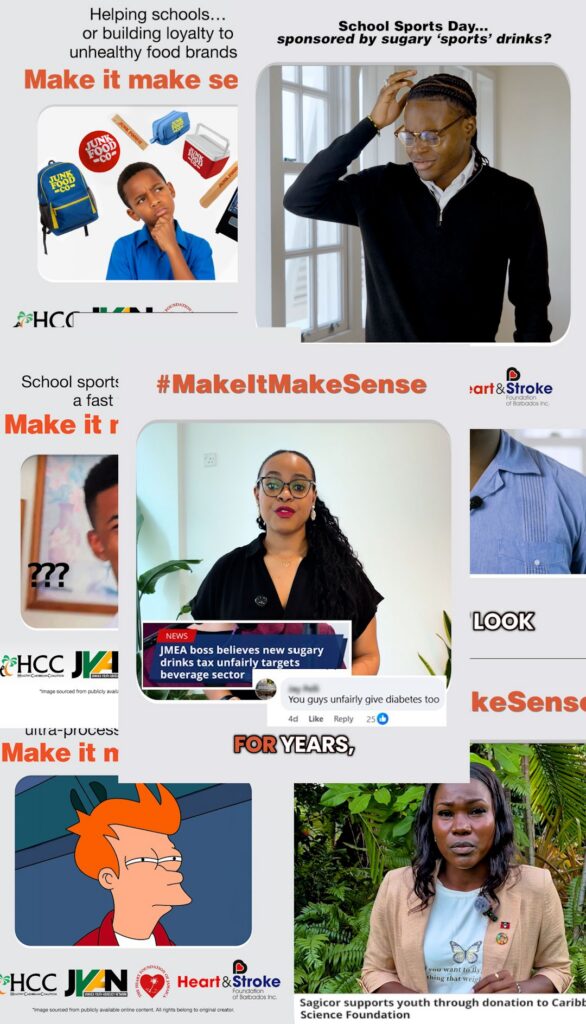
The campaign builds on past advocacy efforts like a previous Make it Make Sense campaign, People Over Profit See the Truth and For the Children, which have helped raise awareness about food industry interference in policymaking and policy implementation, and build support for evidence-informed healthy food policies across the region. This iteration of Make it Make Sense takes a closer look at how industry influence can show up in everyday school environments through sponsorships, branded activities, donations, and other practices that are often normalized or easily overlooked.

Childhood obesity rates in the Caribbean, driven largely by the overconsumption of UPFs high in sugars, sodium and fats, and other additives are higher than the global average and continue to rise, placing children at increased risk of developing noncommunicable diseases (NCDs) such as diabetes, heart disease, and certain cancers at younger ages. These conditions are largely preventable through creating environments that enable healthy eating, physical activity, and overall wellbeing, and schools play a critical role in creating those environments.

Persistent and pervasive interference by the UPF industry continues to shape school environments across the region by normalising UPF company involvement in education and blurring the lines between support, marketing, and influence. This interference affects countries with and without formal school-nutrition policies and can weaken efforts to create consistent, health-promoting school spaces.

Across CARICOM, governments are working toward healthier school environments through a range of initiatives and policy efforts. Yet marketing, including sponsorships, donations and branded activities like UPF company ‘education tours’ remain largely unchecked, providing a significant entry point for UPF companies to influence school culture, shape children’s perceptions, and position themselves as trusted partners.

Through voluntary “healthy schools” pledges, high-visibility sponsorships, and messaging that frames corporate involvement in education as inherently positive, UPF companies normalize their presence in schools, cultivate brand loyalty among children, and create relationships that may conflict with the health promoting environments schools are meant to uphold. Because many schools rely on corporate support to fill funding gaps, these relationships are often seen as necessary or beneficial, even though they send mixed messages and undermine healthy-school norms. HCCs President, Senator Dr. Kenneth Connell signaled the risks associated with increased consumption of ultra-processed foods, including heart disease and type 2 diabetes, starting at a young age. He asked that persons “reflect on their own environments and how marketing of unhealthy food and drinks impact their decision-making with respect to what they consume; and imagine what that same powerful marketing does to our children, especially when it is face-to-face”. 

Shannique Bowden, lawyer and Executive Director of the JYAN, explained: “The Make it Make Sense campaign highlights how some corporate entities use corporate social responsibility to target children, knowing their vulnerabilities, with enticing donations and sponsorships, stating they are filling gaps. These forms of marketing are predatory, and violate child rights principles, and continue to add to our growing problem of child health concerns including obesity and other NCDs”.

Ms. Barbara McGaw, Programme Manager at the HFJ acknowledged the reality of school resource gaps but queried whether support needed to come with promoting unhealthy ultra-processed foods? “Supporting children’s well-being, now more than ever, should be the priority for All, given our fragile communities and high vulnerability to negative health outcomes including rising childhood obesity. The HFJ has been actively working to raise awareness around several health issues which are the result of, for instance, the overconsumption of sugary beverages. The National School Nutrition Policy also includes recommendations for regulation of policies banning or restricting the marketing of High Fat, Sugar and Salt (HFSS) foods in the school environment, including sponsorships, grants, and donations by UPF brands”. Mrs. Sheena Warner-Edwards, HCC Communications Officer relayed similar sentiments but shared that “HCC in its daily tracking has seen an increase in health promoting/neutral companies filling this gap including banks, insurance companies, and even smaller operations such as clothing stores and radio stations.”

The Heart and Stroke Foundation of Barbados (HSFB) is also working to raise awareness about the harmful marketing practices which undermine protective measures which are upheld in schools to ensure the health and well-being of our children. Mrs. Greta Yearwood, Chief Executive Officer of the HSFB, sees the campaign as timely, noting that children spend most of their day in school. Mrs Yearwood pointed out, “What children eat and drink impacts their health outcome as they grow and track into adulthood. If we are serious about protecting 

children and reducing NCDs, then tactics which encourage the consumption of foods high in fats, sugars and salt, targeting children, cannot be permitted. We need to protect public health policies from interference from vested interests!”Unhealthy food and drink brands in our schools have become so commonplace that many of us no longer stop to question it. The Make it Make Sense campaign asks us to do just that.  Members of the public are encouraged to add their names in support of removing unhealthy food and drink marketing from schools at https://www.healthycaribbean.org/make-it-make-sense-campaign-2026/#addnamedt .                     

It is a long established fact that a reader will be distracted by the readable content of a page when looking at its layout. The point of using Lorem Ipsum is that it has a more-or-less normal distribution of letters, as opposed to using ‘Content here, content here’, making it look like readable English. Many desktop publishing packages and web page editors now use Lorem Ipsum as their default model text, and a search for ‘lorem ipsum’ will uncover many web sites still in their infancy.

It is a long established fact that a reader will be distracted by the readable content of a page when looking at its layout. The point of using Lorem Ipsum is that it has a more-or-less normal distribution of letters, as opposed to using ‘Content here, content here’, making it look like readable English. Many desktop publishing packages and web page editors now use Lorem Ipsum as their default model text, and a search for ‘lorem ipsum’ will uncover many web sites still in their infancy.

The point of using Lorem Ipsum is that it has a more-or-less normal distribution of letters, as opposed to using ‘Content here, content here’, making

The point of using Lorem Ipsum is that it has a more-or-less normal distribution of letters, as opposed to using ‘Content here, content here’, making it look like readable English. Many desktop publishing packages and web page editors now use Lorem Ipsum as their default model text, and a search for ‘lorem ipsum’ will uncover many web sites still in their infancy.

EmoNews Contributor

RECENT POSTS

CATEGORIES

Leave a Reply

Your email address will not be published. Required fields are marked *

SUBSCRIBE US

We’re excited to introduce Emonew, Dominica’s fresh new source for general country news. From community updates to national stories, we’re here to keep you informed, connected, and up to date.

Copyright Emonews 2025