/ Jul 30, 2026
Trending
Emonews
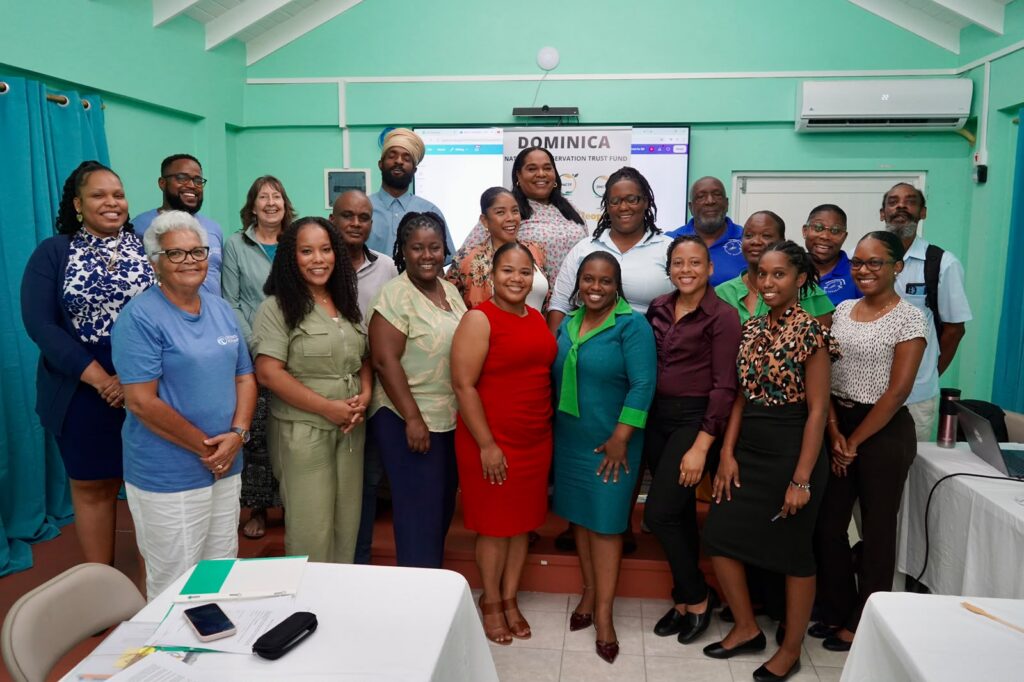
The Dominica National Conservation Trust Fund (DNCTF) recently conducted training in Financial Donor Reporting and Environmental and Social Management Planning (ESMP) for recipients of the Caribbean Biodiversity Fund (CBF) CRAB Pro-Nature Grant on Wednesday 28th July, 2026.
This activity was supported by the Agence Française de Developpement (AFD) and the Fonds Français pour l’Environnement Mondial (FFEM) through the Caribbean Biodiversity Fund (CBF) under the Caribbean Regional Architecture for Biodiversity (CRAB) Project.
The training supported grantees implementing two key initiatives: The Rapid Response to Lethal Yellowing Disease Project and the Enhancing Coral Reef Restoration, Monitoring, Surveillance and Compliance within the Soufriere and Scotts Head Marine Reserve Project.
Facilitated by Ms. Lyn Baron and Dr. Rhonda Linton, CEO of DNCTF, the training equipped participants with practical knowledge and skills to effectively implement their projects, meet donor requirements and strengthen accountability.
Participants received guidance on financial reporting, approved budgets, record keeping, supporting documentation and value for money, as well as key ESMP areas including environmental and social risk management, stakeholder engagement, grievance mechanisms, gender considerations, Indigenous Peoples, chance and environmental finds, incident reporting, monitoring and waste management.
The training also emphasized ESMP best practices, including identifying risks early, putting mitigation measures in place, engaging stakeholders throughout implementation, properly documenting actions, responding promptly to grievances and incidents, and monitoring whether safeguards are working effectively.
For DNCTF, grant-making goes beyond providing funding. Building the capacity of grantees is critical to ensuring that conservation projects are well managed, accountable and deliver meaningful results for nature and people.
The Dominica National Conservation Trust Fund (DNCTF) recently conducted training in Financial Donor Reporting and Environmental and Social Management Planning (ESMP) for recipients of the Caribbean Biodiversity Fund (CBF) CRAB Pro-Nature Grant on Wednesday 28th July, 2026.
This activity was supported by the Agence Française de Developpement (AFD) and the Fonds Français pour l’Environnement Mondial (FFEM) through the Caribbean Biodiversity Fund (CBF) under the Caribbean Regional Architecture for Biodiversity (CRAB) Project.
The training supported grantees implementing two key initiatives: The Rapid Response to Lethal Yellowing Disease Project and the Enhancing Coral Reef Restoration, Monitoring, Surveillance and Compliance within the Soufriere and Scotts Head Marine Reserve Project.
Facilitated by Ms. Lyn Baron and Dr. Rhonda Linton, CEO of DNCTF, the training equipped participants with practical knowledge and skills to effectively implement their projects, meet donor requirements and strengthen accountability.
Participants received guidance on financial reporting, approved budgets, record keeping, supporting documentation and value for money, as well as key ESMP areas including environmental and social risk management, stakeholder engagement, grievance mechanisms, gender considerations, Indigenous Peoples, chance and environmental finds, incident reporting, monitoring and waste management.
The training also emphasized ESMP best practices, including identifying risks early, putting mitigation measures in place, engaging stakeholders throughout implementation, properly documenting actions, responding promptly to grievances and incidents, and monitoring whether safeguards are working effectively.
For DNCTF, grant-making goes beyond providing funding. Building the capacity of grantees is critical to ensuring that conservation projects are well managed, accountable and deliver meaningful results for nature and people.
It is a long established fact that a reader will be distracted by the readable content of a page when looking at its layout. The point of using Lorem Ipsum is that it has a more-or-less normal distribution of letters, as opposed to using ‘Content here, content here’, making it look like readable English. Many desktop publishing packages and web page editors now use Lorem Ipsum as their default model text, and a search for ‘lorem ipsum’ will uncover many web sites still in their infancy.
The point of using Lorem Ipsum is that it has a more-or-less normal distribution of letters, as opposed to using ‘Content here, content here’, making
The point of using Lorem Ipsum is that it has a more-or-less normal distribution of letters, as opposed to using ‘Content here, content here’, making it look like readable English. Many desktop publishing packages and web page editors now use Lorem Ipsum as their default model text, and a search for ‘lorem ipsum’ will uncover many web sites still in their infancy.
We’re excited to introduce Emonew, Dominica’s fresh new source for general country news. From community updates to national stories, we’re here to keep you informed, connected, and up to date.
Copyright Emonews 2025