/ Aug 24, 2026
Trending
When I think back to my school days, I remember the excitement of sports day – the energy in the air, the sense of community, and the pride of cheering on my classmates. I also remember the junk food. The sweet drinks, the salty snacks, the candy bars – they were everywhere. Whether it was the concession stands selling chips and sodas or the ultra processed product (UPP) brands plastered across the larger-than-life banners, unhealthy food and beverages were a constant presence. At the time, it felt normal, even fun. But now, as a young adult working in the sports and fitness space, I see how some companies use these events as a larger strategy to shape our habits, which then harms our health.
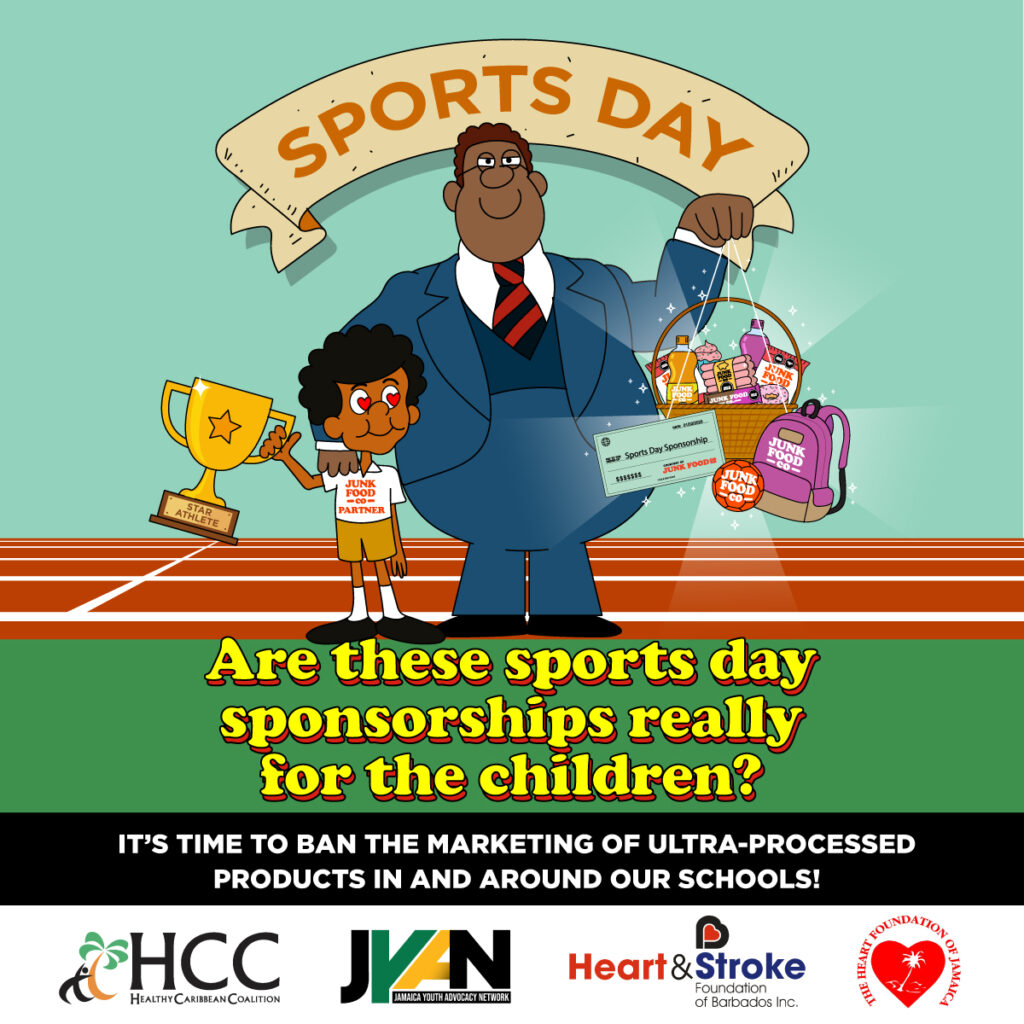
This kind of corporate influence is one of the many systemic failures fuelling exorbitant rates of obesity. Earlier last month, World Obesity Day (commemorated on March 4th) highlighted the theme “Changing Systems, Healthier Lives”, reminding us that tackling obesity requires shifting the focus from individuals to the broader systems and environments that shape our health. This shift is especially urgent in the spaces where children grow, learn and play.
A Win for Them, a Loss for Us
The Healthy Caribbean Coalition’s Make It Make Sense campaign highlights exactly what I’ve come to realize: there’s a clear contradiction in unhealthy food brands’ support for youth sports. There’s an image from this campaign that stuck with me. It shows a child about to run across the finish line but the archway is an advertisement for an unhealthy ultra-processed product. This perfectly captures what I now see so clearly. These brands funding our sports may seem generous, but they’re really trying to secure future customers, and they are trying to show a link between being a healthy sports competitor and consuming their unhealthy products.
When children see these logos plastered on banners on sports day or see their schools accept sponsorships from these companies, it sends a powerful message – one that normalizes unhealthy products and makes them seem like an essential part of sports and success. One in three Caribbean children experiences overweight or obesity. Studies show that exposure to unhealthy UPP marketing directly influences children’s eating habits, contributing to increased rates of obesity, type 2 diabetes and hypertension in children. What’s worse, this unhealthy eating and resulting health problems often persist into adulthood, creating a cycle of poor health that’s hard to break.
When Marketing Interferes with Policy
School nutrition policies are designed to encourage healthy school food environments and to improve the health and future of children. This objective is directly challenged by the unhealthy food and beverage industry, whose marketing tactics are focussed on increasing brand visibility, loyalty, sales and consumption. Schools should be safe spaces where kids learn to make healthy choices, but the unhealthy food and beverage industry is undermining that. Through sponsorships of sports events or donations of branded equipment – marketed as “corporate social responsibility” – these companies push unhealthy products on young, impressionable audiences. But the impact goes even further. What started as a question about marketing to kids led me to a much bigger issue: how these sponsorships shape the policies that are supposed to protect us.
I asked Professor Alafia Samuels, Honorary Professor, Caribbean Institute for Health Research, University of the West Indies, Jamaica, whether these sponsorships actually influence policy, and her response was straightforward. “Yes, these sponsorships can delay, weaken and even prevent advancements in school nutrition policies. Schools lacking sufficient government funding, often rely on unhealthy food companies for financial support and this reliance makes schools and Ministries of Education reluctant to support policies like marketing regulations in school, especially since sponsorships provide built-in marketing opportunities.” However, Professor Samuels remained optimistic about the solutions noting, “We need to seek and encourage sponsorships from health-promoting and health-neutral companies e.g. sports goods and banking. Although some may be reluctant to replace health-harming sponsorships, we are already starting to see sectors like banking stepping in.”
Time to Bench Unhealthy Sponsorships
Research shows that children see more marketing than adults, and they’re also more easily influenced by it. Unlike adults, they don’t yet have the skills to recognize when they’re being targeted by ads, making them especially vulnerable. We don’t allow tobacco and alcohol companies to market to kids, so why do we let unhealthy food and drink brands do it? It’s time to treat unhealthy food marketing like we do other public health threats and put stronger protections in place. To achieve this, a multi-pronged approach is necessary:
Shifting the focus from individual responsibility to the broader systems that influence our health is critical. The presence of unhealthy food marketing in school sports is not just a minor issue – it’s a systemic problem that perpetuates poor health outcomes for future generations. To create healthier futures for our children, we must stand up against these corporate influences and demand comprehensive, effective school nutrition policies.

Author Bio:
Romario Griffith is a certified strength and conditioning coach, personal trainer, nutrition coach and member of Healthy Caribbean Youth. He specializes in educating his clients and the public alike about ways to lead more active, healthier lifestyles. From developing better exercise and eating habits to fundamentally challenging and transforming mindsets about what a healthy lifestyle is.
When I think back to my school days, I remember the excitement of sports day – the energy in the air, the sense of community, and the pride of cheering on my classmates. I also remember the junk food. The sweet drinks, the salty snacks, the candy bars – they were everywhere. Whether it was the concession stands selling chips and sodas or the ultra processed product (UPP) brands plastered across the larger-than-life banners, unhealthy food and beverages were a constant presence. At the time, it felt normal, even fun. But now, as a young adult working in the sports and fitness space, I see how some companies use these events as a larger strategy to shape our habits, which then harms our health.
This kind of corporate influence is one of the many systemic failures fuelling exorbitant rates of obesity. Earlier last month, World Obesity Day (commemorated on March 4th) highlighted the theme “Changing Systems, Healthier Lives”, reminding us that tackling obesity requires shifting the focus from individuals to the broader systems and environments that shape our health. This shift is especially urgent in the spaces where children grow, learn and play.
A Win for Them, a Loss for Us
The Healthy Caribbean Coalition’s Make It Make Sense campaign highlights exactly what I’ve come to realize: there’s a clear contradiction in unhealthy food brands’ support for youth sports. There’s an image from this campaign that stuck with me. It shows a child about to run across the finish line but the archway is an advertisement for an unhealthy ultra-processed product. This perfectly captures what I now see so clearly. These brands funding our sports may seem generous, but they’re really trying to secure future customers, and they are trying to show a link between being a healthy sports competitor and consuming their unhealthy products.
When children see these logos plastered on banners on sports day or see their schools accept sponsorships from these companies, it sends a powerful message – one that normalizes unhealthy products and makes them seem like an essential part of sports and success. One in three Caribbean children experiences overweight or obesity. Studies show that exposure to unhealthy UPP marketing directly influences children’s eating habits, contributing to increased rates of obesity, type 2 diabetes and hypertension in children. What’s worse, this unhealthy eating and resulting health problems often persist into adulthood, creating a cycle of poor health that’s hard to break.
When Marketing Interferes with Policy
School nutrition policies are designed to encourage healthy school food environments and to improve the health and future of children. This objective is directly challenged by the unhealthy food and beverage industry, whose marketing tactics are focussed on increasing brand visibility, loyalty, sales and consumption. Schools should be safe spaces where kids learn to make healthy choices, but the unhealthy food and beverage industry is undermining that. Through sponsorships of sports events or donations of branded equipment – marketed as “corporate social responsibility” – these companies push unhealthy products on young, impressionable audiences. But the impact goes even further. What started as a question about marketing to kids led me to a much bigger issue: how these sponsorships shape the policies that are supposed to protect us.
I asked Professor Alafia Samuels, Honorary Professor, Caribbean Institute for Health Research, University of the West Indies, Jamaica, whether these sponsorships actually influence policy, and her response was straightforward. “Yes, these sponsorships can delay, weaken and even prevent advancements in school nutrition policies. Schools lacking sufficient government funding, often rely on unhealthy food companies for financial support and this reliance makes schools and Ministries of Education reluctant to support policies like marketing regulations in school, especially since sponsorships provide built-in marketing opportunities.” However, Professor Samuels remained optimistic about the solutions noting, “We need to seek and encourage sponsorships from health-promoting and health-neutral companies e.g. sports goods and banking. Although some may be reluctant to replace health-harming sponsorships, we are already starting to see sectors like banking stepping in.”
Time to Bench Unhealthy Sponsorships
Research shows that children see more marketing than adults, and they’re also more easily influenced by it. Unlike adults, they don’t yet have the skills to recognize when they’re being targeted by ads, making them especially vulnerable. We don’t allow tobacco and alcohol companies to market to kids, so why do we let unhealthy food and drink brands do it? It’s time to treat unhealthy food marketing like we do other public health threats and put stronger protections in place. To achieve this, a multi-pronged approach is necessary:
Shifting the focus from individual responsibility to the broader systems that influence our health is critical. The presence of unhealthy food marketing in school sports is not just a minor issue – it’s a systemic problem that perpetuates poor health outcomes for future generations. To create healthier futures for our children, we must stand up against these corporate influences and demand comprehensive, effective school nutrition policies.
Author Bio:
Romario Griffith is a certified strength and conditioning coach, personal trainer, nutrition coach and member of Healthy Caribbean Youth. He specializes in educating his clients and the public alike about ways to lead more active, healthier lifestyles. From developing better exercise and eating habits to fundamentally challenging and transforming mindsets about what a healthy lifestyle is.