/ Jul 17, 2026
Trending

News Elementor

RECENT NEWS

OECS French Member States Promote Regional Integration Through Dual Cooperation and Security conference

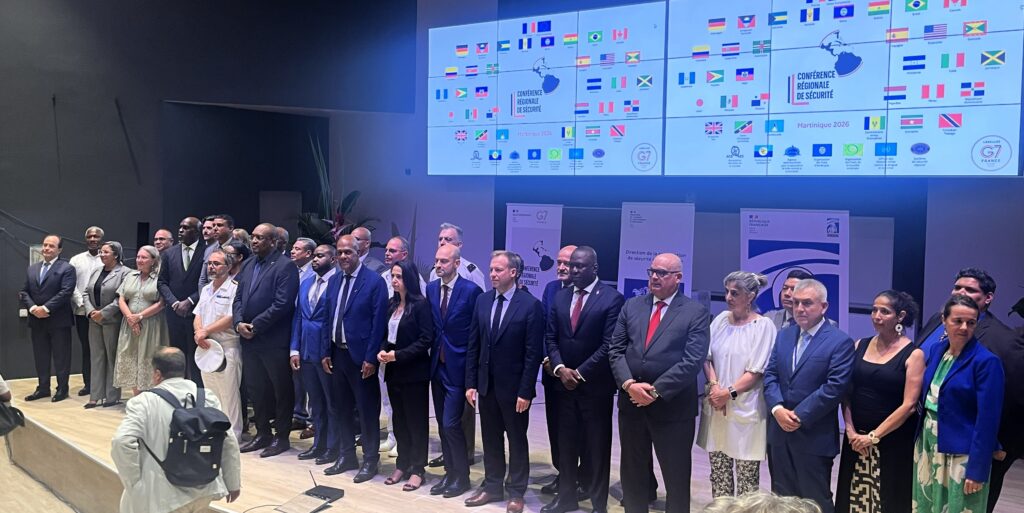
The Territorial Collectivity of Martinique (CTM) hosted the 19th Antilles-Guyane Regional Cooperation Conference (CCRAG) alongside the Conférence Régionale de Sécurité des Antilles (Antilles Regional Security Conference) at the Université des Antilles in Martinique, from July 1 to 3.

Under the stewardship of His Excellency Arnaud Mentré, France Ambassador at-large for regional cooperation in the Atlantic region, the 19th CCRAG was an opportunity for stakeholders in the French Caribbean territories to meet and build together the path for these territories’ integration into their regional ecosystem. General Counsel Mr. Dwight Lay and Cooperation Officer Mr. Mendy Kilo represented the OECS Commission.

Hon. President Letchimy, in his opening remarks, emphasised regional integration’s “vital importance” for the economic development of Martinique. President Letchimy called for renegotiations with France and the EU in the framework of the EU-ACP for deeper participation in the discussions on trade between the region and the European Union, given its unique belonging within the European Union and its recent accession to CARICOM.

More Autonomy Within French Overseas Territories

On July 1, on the margins of the conference, Martinique signed an agreement with the French State to open doors for a discussion on expanding normative powers at a local level in Martinique, furthering autonomous decision-making without rupturing its inclusion in the French Republic. President Letchimy highlighted the urgency to modernise the cooperation apparatus:

“We have no choice but to seek different supply chain pathways; we have no choice but to work with all the Caribbean countries in research and development, innovation and biodiversity”.

Hon. President Louis Mussington of the Collectivité of Saint Martin reinforced this call for more adaptation to the local context in the framework of their shared European Union membership.

President Mussington stated, “It is time to go beyond paradoxes. It is time to modernize our working methods, for [the] convergence of our interests in the region supported by the reinforcement of our capacity of action.”

Recalling Saint Martin’s accession to the Organisation of Eastern Caribbean States (OECS) in 2025, President Mussington also stated:

“Regional Caribbean cooperation never made as much sense as of now, given the rise of the economic insecurity sentiment in this global context. We need to be creative to imagine a multisectoral cooperation which takes into account our status.”

OECS Creative Sector

Saint Martin has emphasised that cultural industries are a vehicle for sectoral economic integration and economic development. President Louis Mussington proposed the creation of a Caribbean Audiovisual and Cinema Network to the OECS. This initiative, announced at the 49th OECS Commissioners Meeting in April 2026, was formally presented to the OECS Authority in June 2026. The OECS Commission, through its participation in a series of workshops, also shared the findings of the 2025 OECS Creative Sector Survey. These findings will help inform the development of the OECS Orange Economy Strategy, which seeks to support a more coordinated regional approach to production, co-production, skills development, financing, and distribution.

Mr Patrick Sellin, representative of the Regional Council of Guadeloupe, supported statements made by its counterparts and stressed the need for relevant projects to further regional integration.

“Experience teaches us that regional integration cannot be decreed. It is built with consistency, confidence, and method. It relies on an affirmed political will, solid institutions, and projects useful to our populations.”

Regional Security

This year, the CCRAG conference was paired with the Conférence Régionale de Sécurité des Antilles (Antilles Regional Security Conference), providing an opportunity to convene with participants from across the ​ Caribbean region and partners from Latin America to organise a common front against drug trafficking.

Both events were attended by several officials, including the French Minister for Europe and Foreign Affairs, Hon. Jean-Noël Barrot; Minister for Overseas France, Hon. Naïma Moutchou; as well as the Minister Delegate to the French Minister of the Interior, Hon. Jean-Didier Berger. The French State announced the reinforcement of its strategies and resources to fight against drug trafficking in its outermost territories and cooperation with neighbouring countries. In 2025, the French authorities announced that 42 tons out of the 81 tons of drugs seized at a national level were seized in the Caribbean region.

Addressing the audience at this event, Hon. Roosevelt Skerrit, Prime Minister of Dominica, recognised the importance of this strategic meeting and insisted on the need for an agile and all-encompassing response to security challenges:

“Security today must be viewed differently. It extends well beyond policing and defense. It includes protecting our maritime borders, strengthening cybersecurity, securing energy and food systems, and building resilience to natural disasters. These issues are felt collectively, and our response must be fully integrated. We cannot speak about security in isolation. For countries like ours, security is inseparable from climate resilience and economic stability.”

The meeting provided an opportunity to organise working groups on common investigative methods, joint judicial procedures, and information sharing on criminal activities. A common declaration was issued at the end of the three-day gathering. The “Martinique Declaration”, which was endorsed on July 3, therefore, constitutes a general call for action to counter criminal activities in the region.

Other participants in the joint event comprised the representatives of the French national and outermost regions authorities; members of the French parliament, Caribbean police forces, military and judicial administrations, Caribbean ministers and representatives with responsibility for crime prevention, justice or external affairs including Hon. Jeremiah Norbert, Minister for Home Affairs, Crime Prevention, Conflict Resolution and Persons with Disabilities, Saint-Lucia; Hon. Gareth Wilkin, Attorney General & Minister of Justice and Legal Affairs. Also present were the Executive Director of the Regional Security System (RSS), Rear Admiral Errington Ricardo Shurland; Secretary General of the Association of Caribbean States (ACS), Her Excellency Noemí Espinoza Madrid; the Organisation of American States (OAS) Assistant Secretary General Laura Gil, and the United Nations Office on Drugs and Crime (UNODC).

The Territorial Collectivity of Martinique (CTM) hosted the 19th Antilles-Guyane Regional Cooperation Conference (CCRAG) alongside the Conférence Régionale de Sécurité des Antilles (Antilles Regional Security Conference) at the Université des Antilles in Martinique, from July 1 to 3.

Under the stewardship of His Excellency Arnaud Mentré, France Ambassador at-large for regional cooperation in the Atlantic region, the 19th CCRAG was an opportunity for stakeholders in the French Caribbean territories to meet and build together the path for these territories’ integration into their regional ecosystem. General Counsel Mr. Dwight Lay and Cooperation Officer Mr. Mendy Kilo represented the OECS Commission.

Hon. President Letchimy, in his opening remarks, emphasised regional integration’s “vital importance” for the economic development of Martinique. President Letchimy called for renegotiations with France and the EU in the framework of the EU-ACP for deeper participation in the discussions on trade between the region and the European Union, given its unique belonging within the European Union and its recent accession to CARICOM.

More Autonomy Within French Overseas Territories

On July 1, on the margins of the conference, Martinique signed an agreement with the French State to open doors for a discussion on expanding normative powers at a local level in Martinique, furthering autonomous decision-making without rupturing its inclusion in the French Republic. President Letchimy highlighted the urgency to modernise the cooperation apparatus:

“We have no choice but to seek different supply chain pathways; we have no choice but to work with all the Caribbean countries in research and development, innovation and biodiversity”.

Hon. President Louis Mussington of the Collectivité of Saint Martin reinforced this call for more adaptation to the local context in the framework of their shared European Union membership.

President Mussington stated, “It is time to go beyond paradoxes. It is time to modernize our working methods, for [the] convergence of our interests in the region supported by the reinforcement of our capacity of action.”

Recalling Saint Martin’s accession to the Organisation of Eastern Caribbean States (OECS) in 2025, President Mussington also stated:

“Regional Caribbean cooperation never made as much sense as of now, given the rise of the economic insecurity sentiment in this global context. We need to be creative to imagine a multisectoral cooperation which takes into account our status.”

OECS Creative Sector

Saint Martin has emphasised that cultural industries are a vehicle for sectoral economic integration and economic development. President Louis Mussington proposed the creation of a Caribbean Audiovisual and Cinema Network to the OECS. This initiative, announced at the 49th OECS Commissioners Meeting in April 2026, was formally presented to the OECS Authority in June 2026. The OECS Commission, through its participation in a series of workshops, also shared the findings of the 2025 OECS Creative Sector Survey. These findings will help inform the development of the OECS Orange Economy Strategy, which seeks to support a more coordinated regional approach to production, co-production, skills development, financing, and distribution.

Mr Patrick Sellin, representative of the Regional Council of Guadeloupe, supported statements made by its counterparts and stressed the need for relevant projects to further regional integration.

“Experience teaches us that regional integration cannot be decreed. It is built with consistency, confidence, and method. It relies on an affirmed political will, solid institutions, and projects useful to our populations.”

Regional Security

This year, the CCRAG conference was paired with the Conférence Régionale de Sécurité des Antilles (Antilles Regional Security Conference), providing an opportunity to convene with participants from across the ​ Caribbean region and partners from Latin America to organise a common front against drug trafficking.

Both events were attended by several officials, including the French Minister for Europe and Foreign Affairs, Hon. Jean-Noël Barrot; Minister for Overseas France, Hon. Naïma Moutchou; as well as the Minister Delegate to the French Minister of the Interior, Hon. Jean-Didier Berger. The French State announced the reinforcement of its strategies and resources to fight against drug trafficking in its outermost territories and cooperation with neighbouring countries. In 2025, the French authorities announced that 42 tons out of the 81 tons of drugs seized at a national level were seized in the Caribbean region.

Addressing the audience at this event, Hon. Roosevelt Skerrit, Prime Minister of Dominica, recognised the importance of this strategic meeting and insisted on the need for an agile and all-encompassing response to security challenges:

“Security today must be viewed differently. It extends well beyond policing and defense. It includes protecting our maritime borders, strengthening cybersecurity, securing energy and food systems, and building resilience to natural disasters. These issues are felt collectively, and our response must be fully integrated. We cannot speak about security in isolation. For countries like ours, security is inseparable from climate resilience and economic stability.”

The meeting provided an opportunity to organise working groups on common investigative methods, joint judicial procedures, and information sharing on criminal activities. A common declaration was issued at the end of the three-day gathering. The “Martinique Declaration”, which was endorsed on July 3, therefore, constitutes a general call for action to counter criminal activities in the region.

Other participants in the joint event comprised the representatives of the French national and outermost regions authorities; members of the French parliament, Caribbean police forces, military and judicial administrations, Caribbean ministers and representatives with responsibility for crime prevention, justice or external affairs including Hon. Jeremiah Norbert, Minister for Home Affairs, Crime Prevention, Conflict Resolution and Persons with Disabilities, Saint-Lucia; Hon. Gareth Wilkin, Attorney General & Minister of Justice and Legal Affairs. Also present were the Executive Director of the Regional Security System (RSS), Rear Admiral Errington Ricardo Shurland; Secretary General of the Association of Caribbean States (ACS), Her Excellency Noemí Espinoza Madrid; the Organisation of American States (OAS) Assistant Secretary General Laura Gil, and the United Nations Office on Drugs and Crime (UNODC).
It is a long established fact that a reader will be distracted by the readable content of a page when looking at its layout. The point of using Lorem Ipsum is that it has a more-or-less normal distribution of letters, as opposed to using ‘Content here, content here’, making it look like readable English. Many desktop publishing packages and web page editors now use Lorem Ipsum as their default model text, and a search for ‘lorem ipsum’ will uncover many web sites still in their infancy.

It is a long established fact that a reader will be distracted by the readable content of a page when looking at its layout. The point of using Lorem Ipsum is that it has a more-or-less normal distribution of letters, as opposed to using ‘Content here, content here’, making it look like readable English. Many desktop publishing packages and web page editors now use Lorem Ipsum as their default model text, and a search for ‘lorem ipsum’ will uncover many web sites still in their infancy.

The point of using Lorem Ipsum is that it has a more-or-less normal distribution of letters, as opposed to using ‘Content here, content here’, making

The point of using Lorem Ipsum is that it has a more-or-less normal distribution of letters, as opposed to using ‘Content here, content here’, making it look like readable English. Many desktop publishing packages and web page editors now use Lorem Ipsum as their default model text, and a search for ‘lorem ipsum’ will uncover many web sites still in their infancy.

EmoNews Contributor

RECENT POSTS

CATEGORIES

Leave a Reply

Your email address will not be published. Required fields are marked *

SUBSCRIBE US

We’re excited to introduce Emonew, Dominica’s fresh new source for general country news. From community updates to national stories, we’re here to keep you informed, connected, and up to date.

Copyright Emonews 2025