/ May 28, 2026
Trending

News Elementor

RECENT NEWS

Regional Partners Align Priorities for Green and Blue Economy Projects in the  Caribbean

Representatives from regional institutions,  governments, training institutions, marine protected areas, business support organizations,  private sector and civil society met in Rodney Bay, Saint Lucia from 21 to 24 April 2026 for the  Implementation Alignment Workshop under the “Green & Blue Skills” and “Blue Economy”  projects, implemented by the Deutsche Gesellschaft für Internationale Zusammenarbeit (GIZ)  GmbH and commissioned by the German Federal Ministry for Economic Cooperation and  Development in cooperation with CARICOM. 

The two regional projects aim to strengthen skills development, sustainable livelihoods and  economic opportunities in the Caribbean’s Green and Blue Economy sectors across four  islands: Saint Lucia, Grenada, Dominica, and Saint Vincent and the Grenadines. This includes  supporting technical and vocational training systems, youth employment and  entrepreneurship, as well as sustainable marine-based businesses and coastal community  development. “This workshop created a rare space where education, environment and  business actors could jointly translate regional priorities into concrete implementation steps.  Cross-sector collaboration is essential to ensure that Green and Blue Economy initiatives are  not only well aligned at regional level but also deliver tangible benefits for people and  communities across the Caribbean.” – Sabine Klaus, Head of Programme. 

Over four days, participants worked together to align regional priorities with national needs and  identify practical measures to strengthen skills development, sustainable livelihoods, marine  resource management and support for micro, small and medium-sized enterprises in the  Caribbean. “What this workshop has done is bring all the agencies together and cause the  agencies to talk to each other. And because we’re so small and we’re right next to each other,  having a regional approach is so important. […] We are seeing significant strides in learning  from each other and together. […] In this workshop we are defining the pathways and the roles  and responsibilities. […] I think this is extremely important.” – Dr. Marie-Louise Felix, Workshop  Facilitator. This sentiment was echoed by the participants who praised the workshop as a  milestone event, noting it was the first time such a diverse group had convened to exchange  practical ideas for Green and Blue Economy initiatives. Attendees noted that the platform not  only facilitated an invaluable exchange but also established stronger coordination mechanisms  between regional institutions and national stakeholders to ensure effective implementation  across the region. 

Through interactive working sessions, and thematic roundtables, participants identified skills  gaps, and regional implementation challenges to develop a prioritised list of pilot activities and  implementation measures under both projects.
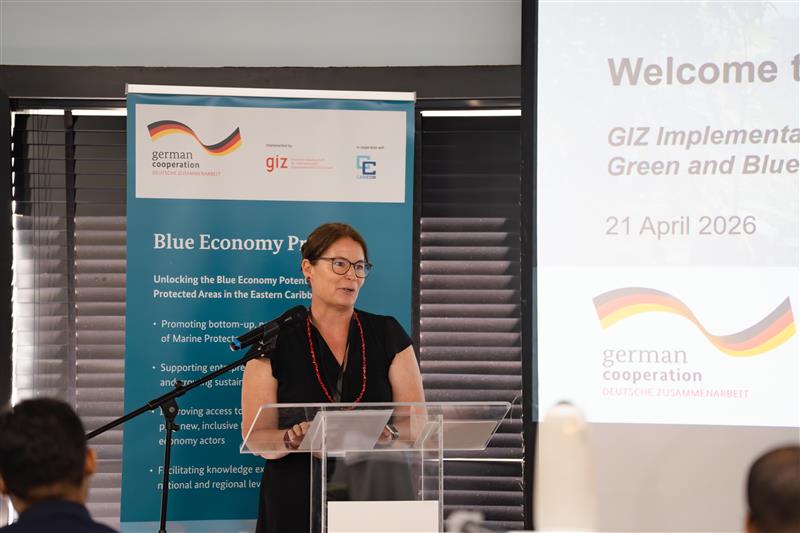
Representatives from regional institutions,  governments, training institutions, marine protected areas, business support organizations,  private sector and civil society met in Rodney Bay, Saint Lucia from 21 to 24 April 2026 for the  Implementation Alignment Workshop under the “Green & Blue Skills” and “Blue Economy”  projects, implemented by the Deutsche Gesellschaft für Internationale Zusammenarbeit (GIZ)  GmbH and commissioned by the German Federal Ministry for Economic Cooperation and  Development in cooperation with CARICOM. 

The two regional projects aim to strengthen skills development, sustainable livelihoods and  economic opportunities in the Caribbean’s Green and Blue Economy sectors across four  islands: Saint Lucia, Grenada, Dominica, and Saint Vincent and the Grenadines. This includes  supporting technical and vocational training systems, youth employment and  entrepreneurship, as well as sustainable marine-based businesses and coastal community  development. “This workshop created a rare space where education, environment and  business actors could jointly translate regional priorities into concrete implementation steps.  Cross-sector collaboration is essential to ensure that Green and Blue Economy initiatives are  not only well aligned at regional level but also deliver tangible benefits for people and  communities across the Caribbean.” – Sabine Klaus, Head of Programme. 

Over four days, participants worked together to align regional priorities with national needs and  identify practical measures to strengthen skills development, sustainable livelihoods, marine  resource management and support for micro, small and medium-sized enterprises in the  Caribbean. “What this workshop has done is bring all the agencies together and cause the  agencies to talk to each other. And because we’re so small and we’re right next to each other,  having a regional approach is so important. […] We are seeing significant strides in learning  from each other and together. […] In this workshop we are defining the pathways and the roles  and responsibilities. […] I think this is extremely important.” – Dr. Marie-Louise Felix, Workshop  Facilitator. This sentiment was echoed by the participants who praised the workshop as a  milestone event, noting it was the first time such a diverse group had convened to exchange  practical ideas for Green and Blue Economy initiatives. Attendees noted that the platform not  only facilitated an invaluable exchange but also established stronger coordination mechanisms  between regional institutions and national stakeholders to ensure effective implementation  across the region. 

Through interactive working sessions, and thematic roundtables, participants identified skills  gaps, and regional implementation challenges to develop a prioritised list of pilot activities and  implementation measures under both projects.

It is a long established fact that a reader will be distracted by the readable content of a page when looking at its layout. The point of using Lorem Ipsum is that it has a more-or-less normal distribution of letters, as opposed to using ‘Content here, content here’, making it look like readable English. Many desktop publishing packages and web page editors now use Lorem Ipsum as their default model text, and a search for ‘lorem ipsum’ will uncover many web sites still in their infancy.

It is a long established fact that a reader will be distracted by the readable content of a page when looking at its layout. The point of using Lorem Ipsum is that it has a more-or-less normal distribution of letters, as opposed to using ‘Content here, content here’, making it look like readable English. Many desktop publishing packages and web page editors now use Lorem Ipsum as their default model text, and a search for ‘lorem ipsum’ will uncover many web sites still in their infancy.

The point of using Lorem Ipsum is that it has a more-or-less normal distribution of letters, as opposed to using ‘Content here, content here’, making

The point of using Lorem Ipsum is that it has a more-or-less normal distribution of letters, as opposed to using ‘Content here, content here’, making it look like readable English. Many desktop publishing packages and web page editors now use Lorem Ipsum as their default model text, and a search for ‘lorem ipsum’ will uncover many web sites still in their infancy.

EmoNews Contributor

RECENT POSTS

CATEGORIES

Leave a Reply

Your email address will not be published. Required fields are marked *

SUBSCRIBE US

We’re excited to introduce Emonew, Dominica’s fresh new source for general country news. From community updates to national stories, we’re here to keep you informed, connected, and up to date.

Copyright Emonews 2025